
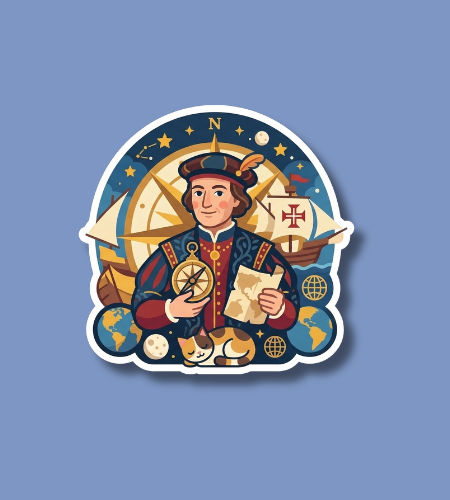
Amerigo Vespucci Day is observed on March 9. This day honors the Florentine explorer and navigator whose realizations changed the European understanding of world geography. While other explorers of his era believed they had reached the outskirts of Asia, Vespucci was the first to demonstrate that the landmasses across the Atlantic were a separate and distinct continent, which he famously termed the New World.
Table of Contents
History of Amerigo Vespucci Day
The observance of this day is tied to the birth of Amerigo Vespucci, who was born on March 9, 1454, in Florence, Italy. Vespucci began his career as a merchant and clerk for the Medici family before moving to Seville, Spain, where he became involved in outfitting ships for long-distance voyages. Between 1497 and 1504, he participated in several expeditions to the Americas, exploring the coastlines of present-day Guyana, Brazil, and Argentina. His detailed letters describing these journeys became widely popular in Europe, providing the public with their first clear descriptions of the indigenous people, flora, and fauna of the Western Hemisphere.
Official recognition of the day gained traction in the United States during the mid-20th century. In 1959, New York Governor Nelson Rockefeller officially proclaimed the holiday to honor the man whose name was given to the American continents. This naming occurred in 1507 when German cartographer Martin Waldseemüller produced a world map and labeled the new land “America,” the Latinized version of Amerigo. Over time, the day has become an occasion to recognize the specific intellectual and scientific contributions Vespucci made to the age of discovery, distinguishing his achievements from those of his contemporaries.
Why is Amerigo Vespucci Day important?
The primary importance of this holiday lies in celebrating the scientific pursuit of truth and the correction of historical misconceptions. Vespucci’s greatest legacy was his ability to look at the evidence before him—stars that did not match the northern sky and coastlines that stretched far beyond existing maps—and conclude that he was standing on a new continent. This realization forced a total revision of global maps and changed the course of human history by opening the door for further exploration, trade, and the eventual formation of modern American nations.
For many, the day is also a significant celebration of Italian-American heritage. It provides an opportunity to reflect on the early cultural and intellectual ties between Italy and the Americas. By focusing on Vespucci’s role as a navigator and cosmographer, the holiday emphasizes the importance of education, cartography, and astronomy in shaping the modern world. It serves as a reminder that the name of the country and the entire hemisphere is a permanent tribute to a single individual’s dedication to understanding the true shape of the earth.
- Vespucci was the first European to identify the Americas as a separate continent.
- His work led to the first use of the name America on a world map in 1507.
- The holiday highlights the vital role of Italian explorers in global history.
- It recognizes the shift from medieval geography to modern scientific observation.
- The day encourages interest in the history of navigation and mapmaking.
How to Celebrate Amerigo Vespucci Day
Celebrating this day often involves educational activities that focus on the history of exploration. Families and students can spend time looking at historical maps from the 16th century to see how the world was envisioned before and after Vespucci’s voyages. Many people visit planetariums or maritime museums to learn about the celestial navigation techniques that explorers used to cross the Atlantic. Engaging with the “Mundus Novus” or “Soderini Letter” provides a direct look at the primary source documents that first introduced the concept of the New World to European readers.
In communities with strong Italian roots, the day is frequently observed with cultural festivals and traditional meals. Public libraries often hold book displays or lectures focused on the Age of Discovery and the life of Vespucci. For a more personal observance, individuals can trace the origins of the name “America” and how it evolved from a single map label into a global identity. Sharing historical facts online or participating in local historical society events helps raise awareness about the specific legacy of the man for whom the continents are named.
- Study old world maps to see the evolution of the American continents.
- Read excerpts from Vespucci’s letters describing his early voyages.
- Visit a maritime museum to learn about 15th-century sailing technology.
- Attend a lecture or workshop on the history of Italian explorers.
- Use a telescope to observe the stars used for early naval navigation.
Amerigo Vespucci Day Dates Table
| Year | Date | Day |
|---|---|---|
| 2026 | March 9 | Monday |
| 2027 | March 9 | Tuesday |
| 2028 | March 9 | Thursday |
| 2029 | March 9 | Friday |
| 2030 | March 9 | Saturday |
Subscribe to our newsletter and never miss a holiday again!