
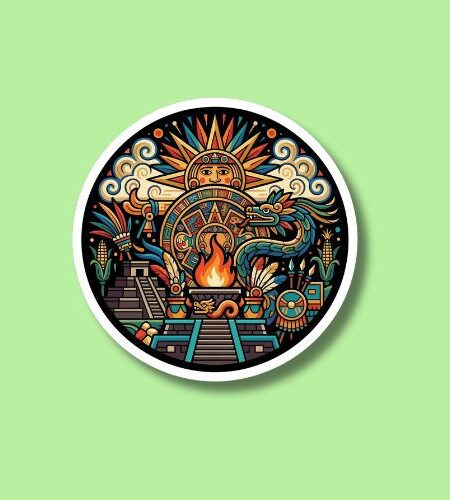
Aztec New Year, or Yancuic Xihuitl, is celebrated annually on March 12. This day marks the beginning of the year according to the Mexica or Aztec calendar, which was traditionally based on the movements of the celestial bodies. The celebration honors the ancient culture of Mesoamerica and the complex mathematical systems that the Aztec people used to track time, seasons, and agricultural cycles.
Table of Contents
History of Aztec New Year
The history of the Aztec New Year is rooted in the solar calendar known as the Xiuhpohualli. This system consisted of 365 days divided into 18 months of 20 days each, with five “empty” or transition days at the end of the year. Historically, the Aztecs viewed time not as a linear path, but as a series of repeating cycles of creation and renewal. The arrival of the new year was a moment to ensure the sun would continue its journey and provide life-sustaining energy for the upcoming planting season.
Following the Spanish conquest in the 16th century, many indigenous traditions were suppressed or blended with European customs. However, Nahua communities preserved the knowledge of the calendar through oral tradition and codices. In the late 20th century, a movement to reclaim indigenous identity led to a resurgence of public celebrations. Today, the holiday is observed in Mexico City and various regions of Mexico, where participants gather to acknowledge their ancestral heritage and the transition into a new solar cycle.
Why is Aztec New Year important?
The significance of this holiday lies in its role as a living link to the pre-Hispanic past of Mexico. It provides an opportunity for modern indigenous groups and the broader public to honor the scientific and cultural achievements of the Aztec civilization. By observing the calendar change, participants recognize the deep connection between human activity and the natural rhythms of the earth, emphasizing a philosophy that values environmental balance and cosmic order.
For many, the day serves as a form of cultural resistance and pride. It keeps the Nahuatl language and traditional arts alive in a rapidly changing world. The rituals performed during the New Year are intended to clear away the stagnant energy of the previous year and invite prosperity for the community. It acts as a focal point for education, encouraging younger generations to study the complex astronomy and philosophy that governed life in the Valley of Mexico centuries ago.
- The day celebrates the sophisticated mathematical and astronomical knowledge of the Aztecs.
- It reinforces the cultural identity of Nahua communities across Mexico and El Salvador.
- The holiday marks a transition point for agricultural planning and seasonal changes.
- It promotes the preservation of the Nahuatl language through traditional greetings.
- The observance highlights the indigenous philosophy of cyclical time and renewal.
How to Celebrate Aztec New Year
Traditional celebrations often begin on the eve of the New Year, March 11, with vigils that lead into the sunrise of the 12th. Participants often wear traditional regalia featuring intricate embroidery and vibrant quetzal feather headdresses. Ceremonial dances, performed to the rhythmic beat of the huehuetl drum, are a central feature of the festivities. These dances are not merely performances but are considered offerings to the deities associated with the wind, rain, and sun.
Observers also engage in the symbolic burning of a flag that represents the passing year, which is then replaced with a new one to represent the future. It is common to light aromatic ocote pine candles to purify the air and create a sacred space for the transition. To conclude the rituals, many people blow into conch shells to signal the arrival of the new year, a practice that echoes the ancient methods used to announce significant events and religious ceremonies.
- Attend a traditional dance ceremony featuring percussion and colorful costumes.
- Burn aromatic resin or pine candles to symbolize the clearing of old energy.
- Learn traditional Nahuatl greetings to share with friends and family.
- Prepare and eat indigenous foods such as tamales or corn-based dishes.
- Listen to the sound of conch shells used to herald the new solar cycle.
Aztec New Year Dates Table
| Year | Date | Day |
|---|---|---|
| 2026 | March 12 | Thursday |
| 2027 | March 12 | Friday |
| 2028 | March 12 | Sunday |
| 2029 | March 12 | Monday |
| 2030 | March 12 | Tuesday |
Subscribe to our newsletter and never miss a holiday again!