
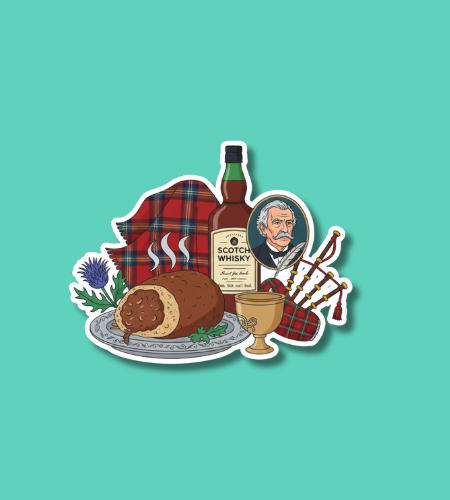
Burns Night is a celebrated cultural holiday observed annually on January 25. This day commemorates the life and literary contributions of Robert Burns, the national poet of Scotland, and is marked by traditional dinners known as Burns Suppers held across the globe.
Table of Contents
History of Burns Night
The tradition began shortly after the poet’s death in 1796. The very first Burns Supper was held on July 21, 1801, by a group of his close friends at Burns Cottage in Alloway to mark the fifth anniversary of his passing. The evening was such a success that the participants decided to reform the gathering as a regular event, eventually moving the date to his birthday, January 25, to celebrate his life rather than his death.
Robert Burns, also known as Rabbie Burns or the Bard of Ayrshire, was born in 1759 and became a pioneer of the Romantic movement. His work, often written in the Scots language, celebrated the beauty of everyday Scottish life and the spirit of the common man. By the mid-19th century, Burns Clubs had formed worldwide, standardizing the rituals of the supper. Today, the holiday serves as a primary expression of Scottish national identity and is celebrated by millions of people, regardless of their ancestral ties to Scotland.
Why is Burns Night important?
This day is significant because it preserves the Scots language and traditional folk music through active performance and recitation. Burns’ poetry, such as “Auld Lang Syne,” has become a global anthem for friendship and New Year celebrations, yet Burns Night provides a deeper context for his larger body of work. The holiday encourages people to engage with literature in a social setting, making poetry accessible and communal rather than purely academic.
The observance also highlights the culinary heritage of Scotland, specifically the preservation of traditional recipes like haggis. It serves as a moment of “Scottishness” that connects the global diaspora, fostering a sense of belonging and shared history. For many, the night is a tribute to the values Burns championed, including egalitarianism, the love of nature, and the importance of honest labor. It is a time when people of all backgrounds come together to celebrate “good fellowship” and the enduring power of the written word.
- It honors the 1759 birth of Scotland’s most famous national poet
- It keeps the Scots language alive through public readings and songs
- It celebrates the “Chieftain of the Pudding-race,” the traditional haggis
- It reinforces global connections among the Scottish diaspora
- It promotes the values of friendship and universal brotherhood
How to Celebrate Burns Night
A traditional Burns Supper follows a specific and theatrical running order. The evening begins with the “Selkirk Grace,” a short prayer of thanks. The highlight of the meal is the “Piping in of the Haggis,” where a bagpiper leads the chef carrying the haggis into the room. The host then performs a dramatic recitation of “Address to a Haggis,” at one point plunging a knife into the casing to reveal the savory filling inside. The meal typically consists of haggis served with “neeps and tatties” (mashed turnips and potatoes), followed by a dessert like Cranachan, a mixture of oats, cream, and whiskey.
Beyond the food, the evening is filled with formal toasts and speeches. The most important is “The Immortal Memory,” a heartfelt tribute to the poet’s life and legacy. This is followed by the “Toast to the Lassies,” a humorous speech about women, and the “Reply from the Lassies,” where a female guest offers a witty response. The celebration concludes with everyone standing, crossing their arms, and joining hands to sing “Auld Lang Syne.” Whether formal or casual, the night is characterized by lively conversation, the sharing of Scotch whisky, and the wearing of tartan.
- Recite the “Address to a Haggis” with dramatic flair before eating
- Serve a traditional meal of haggis accompanied by neeps and tatties
- Raise a “wee dram” of Scotch whisky to toast the Immortal Memory
- Wear a piece of tartan, such as a kilt, scarf, or tie, to show heritage
- End the evening by singing “Auld Lang Syne” with your guests
Burns Night Dates Table
| Year | Date | Day |
|---|---|---|
| 2026 | January 25 | Sunday |
| 2027 | January 25 | Monday |
| 2028 | January 25 | Tuesday |
| 2029 | January 25 | Thursday |
| 2030 | January 25 | Friday |
Subscribe to our newsletter and never miss a holiday again!