
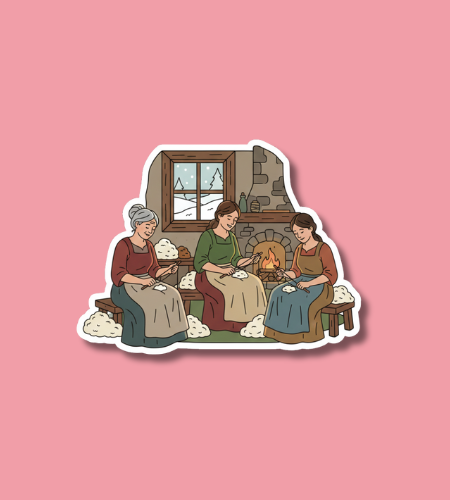
Distaff Day is an unofficial holiday traditionally observed on January 7. This day marks the end of the twelve days of Christmas and represents the time when women historically returned to their domestic duties, particularly the task of spinning thread and yarn.
Table of Contents
History of Distaff Day
The origins of this observance trace back to medieval Europe, where the distaff was a common tool used in hand-spinning to hold unspun flax or wool. Because the period from Christmas to Epiphany was designated as a time of rest from labor, the day immediately following Epiphany became the designated start for resuming work. While the church did not officially recognize a “Saint Distaff,” the name was created as a humorous counterpart to the religious calendar, elevating the importance of everyday household labor to a festive status.
Historically, the day was often characterized by playful social tension between men and women. In rural communities, men would sometimes attempt to burn the flax on the women’s distaffs, while the women would retaliate by dousing the men with buckets of water. This tradition was famously captured in the 17th-century poem “St. Distaff’s Day” by Robert Herrick. As the Industrial Revolution moved textile production from the home to the factory, the practical observance of the holiday faded, though it remained a significant piece of folklore in spinning communities.
Why is Distaff Day important?
This day serves as a historical reminder of the immense amount of labor required to produce basic necessities before the age of mechanization. Spinning was a constant, essential task that occupied women of all social classes, from peasants to noblewomen. By acknowledging the resumption of this work, the holiday highlights the economic and social contributions of women that were often overlooked in formal histories. It provides a unique window into the seasonal rhythms of pre-industrial life where work and holiday were strictly demarcated.
In modern times, the holiday has found new life among fiber artists and hobbyists who seek to preserve ancient crafts. It fosters a sense of continuity with the past and encourages the appreciation of handmade goods in a world dominated by mass production. For many, it is not a day of drudgery but a celebration of skill, patience, and the artistic potential of raw materials. The day also serves as a transition point, helping people shift their focus from the indulgence of the winter holidays back to a productive and structured routine.
- It commemorates the historical resumption of female labor after the Christmas season.
- The holiday honors the ancient craft of hand-spinning and textile production.
- It recognizes the distaff as a universal symbol of women’s work and industry.
- The day provides a cultural link to medieval folklore and seasonal traditions.
- It serves as a modern gathering point for knitters, weavers, and fiber enthusiasts.
How to Celebrate Distaff Day
Many modern participants celebrate by organizing “spin-ins,” where people gather with their spinning wheels or drop spindles to work on projects together. These events often include demonstrations of different fiber types, such as silk, alpaca, or wool, and allow experienced crafters to mentor beginners. If you do not spin, you can observe the day by starting a new knitting, crochet, or sewing project to mark the return to a productive mindset. Some also choose to read Robert Herrick’s poem to connect with the humorous and rowdy history of the day.
Another meaningful way to observe the day is to focus on the transition from holiday festivities to everyday life. This can involve organizing a workspace, cleaning out a craft room, or simply taking a moment to reflect on goals for the coming year. In some regions, historical societies host workshops where attendees can see a distaff in use and learn about the evolution of the textile industry. Sharing photos of your hand-made projects on social media can also help raise awareness of this obscure but culturally rich tradition.
- Host a small gathering for friends to work on fiber-related crafts.
- Learn the basics of how to use a drop spindle or a spinning wheel.
- Read the 1648 poem by Robert Herrick to learn about traditional pranks.
- Visit a local museum or historical site with a textile or spinning exhibit.
- Purchase yarn or raw fiber from a local producer to support modern artisans.
Distaff Day Dates Table
| Year | Date | Day |
|---|---|---|
| 2026 | January 7 | Wednesday |
| 2027 | January 7 | Thursday |
| 2028 | January 7 | Friday |
| 2029 | January 7 | Sunday |
| 2030 | January 7 | Monday |
Subscribe to our newsletter and never miss a holiday again!