
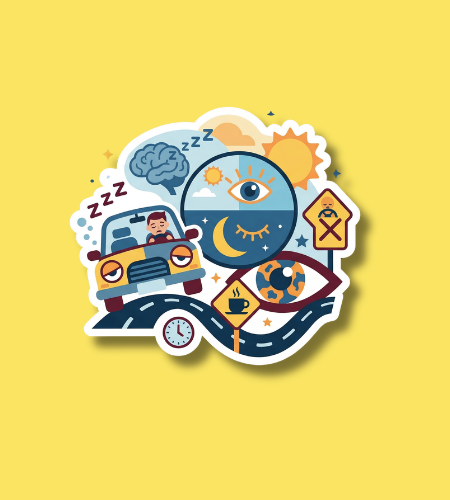
Drowsy Driver Awareness Day is observed on April 6. This critical safety observance aims to educate the public about the extreme dangers of driving while fatigued. It serves as a somber reminder that sleep deprivation can impair a driver just as much as alcohol or drugs, leading to thousands of preventable accidents every year.
Read also about Transit Driver Appreciation Day and National Alcohol Screening Day
Table of Contents
History of Drowsy Driver Awareness Day
The movement for drowsy driving awareness gained significant momentum in the late 1990s and early 2000s, spearheaded by organizations like the National Sleep Foundation (NSF) and the Governors Highway Safety Association (GHSA). These groups recognized that while “drunk driving” was culturally stigmatized, “tired driving” was often seen as a badge of honor or a necessary part of a busy lifestyle.
The specific date of April 6 is often associated with the memory of victims like Ron Schulman, a 21-year-old student whose death in 1995 led his family to establish some of the first awareness campaigns. In 2003, New Jersey became the first state to pass “Maggie’s Law,” which explicitly classifies fatal accidents caused by a driver who has been awake for more than 24 hours as vehicular homicide. Drowsy Driver Awareness Day was established to broaden these state-level efforts into a national conversation about the responsibility every driver has to be well-rested before getting behind the wheel.
Why is Drowsy Driver Awareness Day important?
This day is important because it addresses a “silent” epidemic on our roads. According to the National Highway Traffic Safety Administration (NHTSA), drowsy driving is responsible for over 100,000 police-reported crashes and approximately 800 deaths annually in the United States alone. The holiday highlights that fatigue slows reaction time, decreases awareness, and impairs judgment—making it nearly impossible to respond to sudden hazards or changes in traffic.
The observance is also crucial for debunking common myths about staying awake. Many drivers believe that rolling down the window, turning up the radio, or drinking coffee is enough to overcome exhaustion. Drowsy Driver Awareness Day emphasizes that these are temporary fixes that do not prevent “microsleeps”—brief episodes of sleep lasting only a few seconds that can occur without the driver even realizing it. By focusing on the science of sleep, the day saves lives by encouraging drivers to pull over and rest rather than “powering through.”
- It highlights that 20 hours without sleep is equivalent to a 0.08% blood alcohol content.
- The day educates the public on “microsleeps” and their fatal consequences.
- It recognizes the high-risk groups, including shift workers and long-haul truckers.
- The holiday promotes the “Stop, Nap, and Caffeine” strategy for long trips.
- It honors the memories of those lost to fatigue-related traffic accidents.
How to Observe Drowsy Driver Awareness Day
The most impactful way to observe the day is to perform a personal “sleep audit” before any commute. If you find yourself drifting into other lanes, hitting “rumble strips,” or struggling to remember the last few miles driven, you are already too tired to be on the road. The goal of the day is to normalize the decision to pull over to a safe rest area or call a rideshare service when you feel the heavy eyelids or frequent yawning that signal the onset of sleep.
Education is another key component of the day. You can share infographics on social media using the hashtag #DrowsyDriving to help others recognize the warning signs of fatigue. For parents and teachers, it is an excellent time to talk to young drivers about the dangers of driving home late from social events or after a long study session. Many workplaces also use the day to review their policies for employees who work late shifts or travel frequently, ensuring that safety always takes priority over a deadline.
- Learn the “Red Flags” of drowsy driving, such as frequent blinking and missing exits.
- Pledge to never drive if you have had fewer than six hours of sleep.
- Share road safety tips and statistics with friends and family.
- Support legislation that strengthens penalties for fatigued driving.
- If you feel tired while driving, pull over in a safe, well-lit area for a 20-minute nap.
Drowsy Driver Awareness Day Dates Table
| Year | Date | Day |
|---|---|---|
| 2026 | April 6 | Monday |
| 2027 | April 6 | Tuesday |
| 2028 | April 6 | Thursday |
| 2029 | April 6 | Friday |
| 2030 | April 6 | Saturday |
Subscribe to our newsletter and never miss a holiday again!