
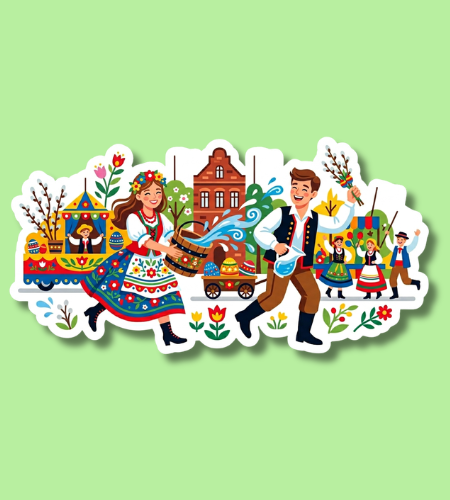
Dyngus Day (also known as Śmigus-Dyngus) is observed on Easter Monday. In 2026, it falls on April 6. This vibrant Polish holiday celebrates the end of the Lenten fast and the joy of the Easter season. Historically a rite of spring, it has evolved into a massive cultural celebration in Poland and within Polish-American communities, characterized by water fights, traditional music, and plenty of polka dancing.
Read also about Holy Monday, Holy Tuesday and Holy Wednesday, Maundy Thursday, Good Friday, Holy Saturday

Table of Contents
History of Dyngus Day
The origins of Dyngus Day are a blend of pagan Slavic traditions and Christian history. Historically, Śmigus involved the symbolic “switching” of legs with pussy willow branches, while Dyngus referred to the practice of throwing water on others. These customs were linked to ancient fertility rites and the arrival of spring. Over time, the holiday became associated with the baptism of Prince Mieszko I in 966 AD, which brought Christianity to Poland. The water used in modern festivities is often seen as a playful nod to this mass baptism that birthed the Polish nation.
In the United States, Dyngus Day found a second home in “Polonia” hubs like Buffalo, New York, and South Bend, Indiana. Following World War II, Polish immigrants brought these traditions to the Midwest, where they transformed from rural village customs into large-scale urban festivals. Buffalo, in particular, has earned the title of the “Dyngus Day Capital of the World,” hosting parades and parties that attract tens of thousands of people annually. The holiday serves as a powerful connection to ancestral roots and a celebration of Polish-American resilience.
Why is Dyngus Day important?
Dyngus Day is important because it preserves the unique folklore and social customs of the Polish people. While many holidays are somber or strictly religious, Dyngus Day provides a lighthearted, communal outlet for joy after the 40 days of Lent. It reinforces ethnic identity through traditional foods like pierogi and kielbasa and keeps the vibrant sounds of polka music alive for younger generations.
Beyond its cultural roots, the day is a celebration of spring’s renewal. The use of water and pussy willow branches—some of the first plants to bud in the spring—symbolizes the “awakening” of the earth. In modern times, the holiday has also become a major economic and social driver for cities with large Polish populations, fostering a sense of civic pride and inviting people of all backgrounds to become “Polish for a day.”
- It commemorates the legendary baptism of Prince Mieszko I in 966 AD.
- The day celebrates the end of Lenten restrictions with a “last blast” party.
- It preserves traditional Slavic spring rites involving water and pussy willows.
- The holiday promotes Polish-American heritage and community unity.
- It highlights the historical “battle of the sexes” where boys and girls take turns splashing water.
How to Observe Dyngus Day
The most iconic way to celebrate is by participating in a “water battle.” Traditionally, boys would splash girls with water on Monday, and girls would get their revenge on Tuesday (though modern celebrations usually combine both into Monday). If you’re attending a festival, expect to see people carrying squirt guns or buckets. Carrying a bunch of pussy willow branches is another classic custom; they are used to playfully tap the legs of friends and family for good luck.
Feasting is a non-negotiable part of the day. You can celebrate by visiting a Polish hall or restaurant to enjoy a “Dyngus Day Plate” featuring pierogi (dumplings), kielbasa (sausage), golabki (cabbage rolls), and chrusciki (angel wing cookies). Wearing red and white—the colors of the Polish flag—and attending a polka dance are also popular ways to join the fun. For many, the highlight of the day is the Dyngus Day Parade, featuring floats, dancers, and traditional folk costumes.
- Join a local parade or festival in a Polish-American “Polonia” district.
- Enjoy a traditional meal of pierogi, kielbasa, and sauerkraut.
- Tap friends with pussy willow branches for “health and good fortune.”
- Wear red and white or “I Love Dyngus Day” apparel.
- Dance the polka at a community hall or local “Beer Garden.”
Subscribe to our newsletter and never miss a holiday again!