
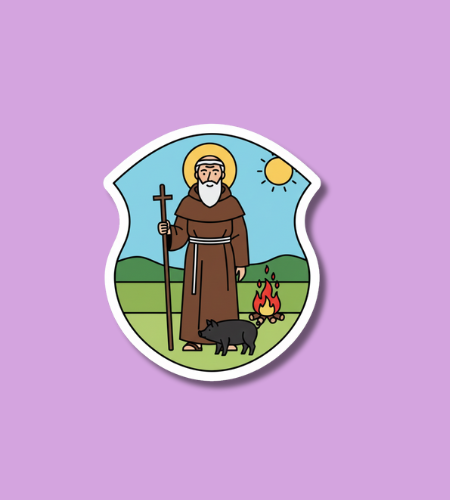
Feast Day of Anthony the Great is observed on January 17. This religious day honors the life and legacy of the Egyptian hermit who is widely recognized as the father of all monks and the founder of Christian monasticism.
Table of Contents
History of Anthony the Great
Saint Anthony was born in Egypt around 251 to a wealthy family of landowners. When he was about 18 years old, his parents passed away, leaving him in charge of his younger sister and a large estate. While attending a church service shortly after, he heard a Gospel reading where Jesus told a rich young man to sell his possessions and give the proceeds to the poor. Anthony took these words literally, distributed his family’s wealth to the needy, placed his sister under the care of a group of Christian virgins, and moved to the outskirts of his village to live a life of prayer.
As he sought deeper solitude, Anthony moved into the desert and lived in a tomb for several years, followed by twenty years in an abandoned Roman fort at Pispir. During this time, he famously struggled against physical and mental temptations, which were later depicted in art and literature as battles with demons in the form of wild animals. His reputation for holiness grew, attracting many followers who wished to imitate his lifestyle. Around 305, he emerged from his seclusion to organize these hermits into the first loose communities of monks, providing them with spiritual guidance before retiring further into the Eastern Desert near the Red Sea, where he died at the age of 105.
Why is Anthony the Great important?
This day is significant because it celebrates the shift from localized asceticism to organized monastic life. Anthony’s decision to move into the deep desert created a new model of Christian devotion that focused on radical isolation, manual labor, and unceasing prayer. His biography, written by Saint Athanasius, became a bestseller of the ancient world and inspired thousands of people across Europe and the Middle East to pursue monastic vocations. His life demonstrated that spiritual discipline could be maintained even in the harshest environments.
The feast day also highlights Anthony’s role as a protector and intercessor. He is the patron saint of skin diseases, often referred to in history as “Saint Anthony’s Fire,” and is frequently invoked for protection against infectious diseases. Because he lived among the desert wildlife and handled livestock, he is also venerated as the patron saint of animals and farmers. His legacy remains a cornerstone for both Eastern Orthodox and Roman Catholic traditions, serving as a reminder of the power of detachment from worldly wealth.
- The day commemorates the founder of organized Christian monasticism.
- It honors the “Original Monk” who pioneered desert asceticism.
- Anthony is recognized for his successful resistance against spiritual temptations.
- The observance highlights his patronage over animals and those with skin ailments.
- It serves as a tribute to one of the most influential figures in early church history.
How to Celebrate (or Observe) Anthony the Great
Many people observe this day by attending a special liturgy or Mass dedicated to the saint. In many rural communities, particularly in Europe and Latin America, a traditional “Blessing of the Animals” takes place on this day. Farmers and pet owners bring their livestock and domestic animals to the church courtyard, where a priest sprinkles them with holy water to seek Saint Anthony’s protection for the coming year. This tradition reinforces the saint’s historical connection to the natural world and the creatures he encountered in the desert.
Another common way to observe the feast is through acts of charity that mirror Anthony’s own renunciation of wealth. Families may donate food or money to the poor, often specifically giving bread to those in need. In some households, “Saint Anthony’s Soup,” a simple and hearty meal made with vegetables and beans, is prepared to reflect the humble and ascetic diet of the desert fathers. Reading excerpts from the “Sayings of the Desert Fathers” or the biography written by Athanasius provides a way to reflect on the saint’s wisdom and his teachings on humility and perseverance.
- Bring pets or livestock to a local church for a traditional animal blessing.
- Prepare a simple meal like vegetable soup to honor his ascetic lifestyle.
- Donate to a local food bank or shelter to help the less fortunate.
- Read a few chapters of the Life of Saint Anthony by Saint Athanasius.
- Light a candle in honor of those suffering from illness or skin conditions.
Feast Day of Anthony the Great Dates Table
Subscribe to our newsletter and never miss a holiday again!