
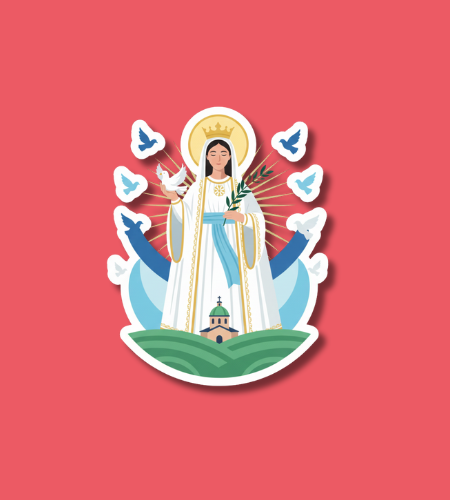
The Feast of Our Lady of Peace is a Roman Catholic liturgical celebration observed annually on January 24. While the universal Church often commemorates this title on July 9, the January date is specifically celebrated in Hawaii and several other American dioceses to honor the Virgin Mary as the Queen of Peace and the patroness of regional cathedrals.
Table of Contents
History of the Feast of Our Lady of Peace
The origins of this devotion date back to 16th-century France. The original wooden statue of Our Lady of Peace was a wedding gift from Jean de Joyeuse to his bride. The statue was eventually entrusted to the Capuchin Franciscans in Paris, where it became a focal point for those seeking intercession during times of war. In 1657, the community erected a larger chapel for the statue, and on July 9 of that year, the image was solemnly blessed in the presence of King Louis XIV. During the French Revolution, the statue was hidden to prevent its destruction and was later given to Peter Coudrin, the founder of the Congregation of the Sacred Hearts of Jesus and Mary.
The specific January 24 celebration is deeply tied to the history of the Catholic Church in Hawaii. When the first missionaries from the Congregation of the Sacred Hearts arrived in Honolulu in 1827, they dedicated their mission to Our Lady of Peace. They built the Cathedral Basilica of Our Lady of Peace, which was formally dedicated in August 1843. However, January 24 was adopted as a primary feast day in the region to mark the specific Marian devotion and its role in the spiritual protection of the islands. The title “Queen of Peace” gained further global prominence in 1917 when Pope Benedict XV officially added it to the Litany of Loreto during the turmoil of World War I.
Why is the Feast of Our Lady of Peace important?
This feast day serves as a spiritual petition for reconciliation and harmony across the globe. In the Catholic tradition, Mary is seen as the mediatrix who leads the faithful to her son, Jesus Christ, who is titled the “Prince of Peace.” The holiday provides a dedicated time for the community to reflect on the necessity of inner peace as a foundation for ending external conflicts. It reminds believers that peace is not merely the absence of war, but a gift from God that requires active cultivation through prayer and charity.
The day is also significant for its cultural impact in specific regions like El Salvador and Hawaii. For Salvadorans, Our Lady of Peace is the national patroness, credited with saving the city of San Miguel from a volcanic eruption in 1787. For the people of Hawaii, the feast honors the oldest Roman Catholic cathedral in continuous use in the United States. It connects local history with universal themes of hope and maternal protection, reinforcing a sense of collective identity through faith.
- It commemorates the historical French statue that survived the French Revolution
- It honors Mary as the primary intercessor for global and personal peace
- It celebrates the patroness of the Diocese of Honolulu and the nation of El Salvador
- It highlights the 1917 addition of “Queen of Peace” to the Litany of Loreto
- It provides a day of prayer for reconciliation among warring nations and factions
How to Celebrate (or Observe) the Feast of Our Lady of Peace
The most common way to observe this day is through the recitation of the Litany of Loreto, which includes the specific title “Queen of Peace.” Many Catholics attend a special Mass where the liturgy focuses on themes of reconciliation and the biblical role of Mary in the story of salvation. In Hawaii, the Cathedral Basilica in Honolulu often hosts special services or processions to honor its patroness. Families may set up a small home altar with a Marian image, an olive branch, and a candle to create a space for quiet reflection.
In El Salvador, the celebration often involves grand processions where the statue of the Virgin is carried through the streets, accompanied by traditional music and prayers. For individual observers, the day is a prompt to perform acts of peace within their own lives, such as forgiving a long-held grudge or reaching out to an estranged family member. Many people also use the day to learn more about the lives of saints who were dedicated to peacemaking. The celebration is marked by a focus on gentleness, humility, and the active pursuit of unity within the community.
- Attend a Mass dedicated to Mary, Queen of Peace
- Recite the Litany of Loreto with a focus on the title of Peace
- Place an olive branch or white flowers near an image of the Virgin Mary
- Make a conscious effort to resolve a personal conflict or offer forgiveness
- Donate to a charity that provides aid to victims of war and displacement
Feast of Our Lady of Peace Dates Table
| Year | Date | Day |
|---|---|---|
| 2026 | January 24 | Saturday |
| 2027 | January 24 | Sunday |
| 2028 | January 24 | Monday |
| 2029 | January 24 | Wednesday |
| 2030 | January 24 | Thursday |
Subscribe to our newsletter and never miss a holiday again!