
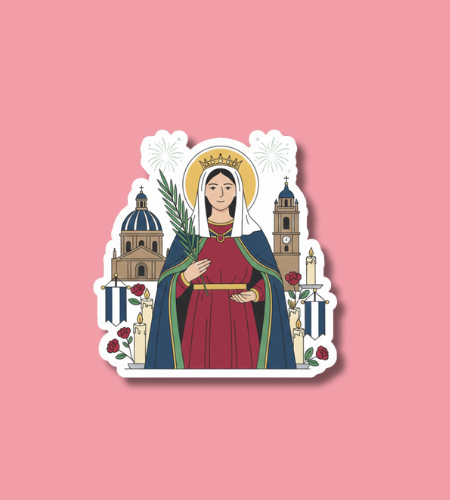
The Feast of St Agatha is observed annually on February 5. This religious and cultural event honors the life and martyrdom of Saint Agatha, the patroness of Catania, Sicily. While the official feast day is a single date on the liturgical calendar, the city of Catania hosts one of the largest religious festivals in the world, with multi-day processions and rituals that attract over one million participants and spectators from across the globe.
Table of Contents
History of Feast of St Agatha
Saint Agatha lived during the 3rd century AD and was born into a noble, wealthy family in Sicily. During the reign of Roman Emperor Decius, who conducted widespread persecutions of Christians, the governor Quintianus sought to marry her. When Agatha rejected his advances and remained committed to her Christian faith, she was subjected to imprisonment and brutal physical torture. Tradition holds that she died in prison on February 5, 251, after suffering numerous trials, including the removal of her breasts and being rolled over hot coals.
The veneration of Saint Agatha began almost immediately after her death. One year later, an eruption of Mount Etna threatened the city of Catania, and local citizens used her burial veil as a shield against the advancing lava. According to local records, the lava stopped just before reaching the city, an event attributed to her intercession. In 1040, her relics were taken to Constantinople, but they were famously returned to Catania in 1126. Since then, the city has maintained a rigorous schedule of annual celebrations to honor her as its primary protector.
Why is Feast of St Agatha important?
The Feast of St Agatha is significant as a testament to religious endurance and regional identity. In Catania, the festival serves as the social and spiritual heartbeat of the city, bringing together people of all ages in a shared display of devotion. It is ranked as the third largest Catholic celebration in the world, following the Holy Week in Seville and the feast of Corpus Domini in Cusco. The holiday preserves centuries-old guild traditions, as different groups of workers maintain and carry the ornate, massive candle structures known as candelore.
Beyond the borders of Sicily, the day holds deep personal importance for specific groups within the church. Saint Agatha is the patron saint of nurses, bakers, bell-founders, and those suffering from breast cancer. Her story of resilience in the face of physical and emotional trauma provides comfort to those facing health challenges. The day also serves as a reminder of the historical Christian resistance to Roman paganism, emphasizing the values of chastity, courage, and unwavering loyalty to one’s beliefs.
- The holiday honors a saint who is one of the seven women commemorated in the Roman Canon of the Mass.
- It recognizes the historical miracle where Agatha’s veil supposedly stopped the lava of Mount Etna.
- The festival preserves the craft of constructing massive, Baroque-style wooden candle towers.
- It provides a platform for survivors of breast cancer to seek spiritual strength and community.
- The event maintains the cultural link between Catania and its pre-medieval heritage.
How to Observe Feast of St Agatha
Observing the feast involves a mix of somber religious attendance and vibrant street festivities. In Catania, participants often wear a “sacco,” which is a traditional white tunic made of cotton, accompanied by a black velvet cap and a rope belt. This outfit symbolizes the nightclothes worn by citizens in 1126 when they rushed into the streets to welcome her relics back home. The main event features a silver carriage, or fercolo, carrying the saint’s bust and relics through the city streets in a procession that can last for over twenty-four hours.
Food plays a central role in the observance, with specific sweets prepared to mirror the saint’s life. “Minne di Sant’Agata,” or small ricotta-filled pastries shaped like breasts, are widely consumed as a direct reference to her martyrdom. Another popular treat is “olivette,” green marzipan olives that recall a legend where an olive tree miraculously grew to hide and feed her during her flight from Roman soldiers. Outside of Sicily, many people observe the day by lighting candles, attending Mass, or performing fire safety checks, as she is also a patroness against fire.
- Attend the “Messa dell’Aurora” or Dawn Mass at the Catania Cathedral.
- Wear white clothing to signify devotion and solidarity with the tradition.
- Prepare or eat cassatelle di Sant’Agata and olivette marzipan sweets.
- Watch the “Candelore” parade where men carry heavy wooden statues on their shoulders.
- Recite prayers for protection against fire, natural disasters, and health issues.
Feast of St Agatha Dates Table
| Year | Date | Day |
|---|---|---|
| 2026 | February 5 | Thursday |
| 2027 | February 5 | Friday |
| 2028 | February 5 | Saturday |
| 2029 | February 5 | Monday |
| 2030 | February 5 | Tuesday |
Subscribe to our newsletter and never miss a holiday again!