
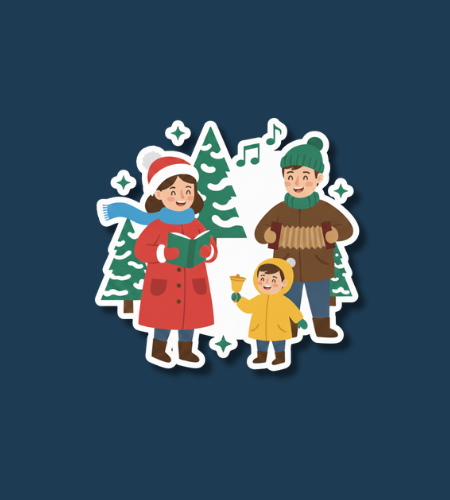
Go Caroling Day is observed annually on December 20. This musical holiday encourages people to bundle up, gather with friends or neighbors, and take their festive spirit to the streets. It is a revival of the centuries-old tradition of going door-to-door to sing seasonal songs, spreading joy and community warmth during the longest nights of the year.
Table of Contents
History of Go Caroling Day
The act of caroling has roots that predate modern Christmas celebrations, originating from the medieval tradition of “wassailing.” In feudal times, wassailers would travel from house to house singing to the health of the homeowners in exchange for food, drink, or money. The word “carol” itself comes from the Old French “carole,” which referred to a circular dance accompanied by singers. While early carols were often pagan songs celebrating the winter solstice, St. Francis of Assisi is credited with bringing energetic, upbeat hymns into Christian services in the 13th century, making the music accessible to common people.
The specific Victorian-style caroling that inspires this holiday became popular in the 19th century. During this era, old traditions were revived and reshaped into the family-friendly activity we recognize today. The publication of collections like Christmas Carols, Ancient and Modern (1833) and the popularity of Charles Dickens’ A Christmas Carol helped cement the image of singers standing in the snow under streetlamps. Go Caroling Day was established to ensure this communal art form survives in an age where digital music often replaces live participation.
Why is Go Caroling Day important?
This holiday is vital for building community connections in a physical, tangible way. In an era of text messages and social media, standing on a neighbor’s porch to sing is a rare act of face-to-face interaction. It breaks down the social barriers that often keep people isolated in their homes. For the recipients, especially the elderly or those unable to leave their houses, a visit from carolers can be the highlight of the season, providing a sense of belonging and reminding them that they are not forgotten.
Additionally, the day preserves a rich musical heritage that is meant to be shared rather than just consumed. Caroling requires no professional training or instruments; it relies simply on the human voice and enthusiasm. It democratizes music, allowing anyone to participate regardless of skill level. By keeping these songs alive through oral tradition and public performance, the holiday maintains a link to the past and ensures that the melodies continue to be a shared cultural language.
- It combats social isolation during the winter months.
- It brings live music directly to local neighborhoods.
- It strengthens bonds between friends and community members.
- It keeps traditional songs and lyrics in the public memory.
- It offers a free, accessible way to celebrate the season.
How to Celebrate Go Caroling Day
To celebrate, you simply need a group of willing voices and a plan. Gather friends, family, or coworkers and print out lyric sheets for classic songs like “Jingle Bells,” “Silent Night,” and “Joy to the World.” Dress in warm layers and map out a route in your neighborhood. You do not need to be a professional choir; the gesture of showing up is more important than perfect pitch. Many groups choose to visit nursing homes, hospitals, or shelters, where the performance is often deeply appreciated by residents.
If you are not able to go out, you can host a caroling party at home. Invite guests over for hot cocoa and cider, and spend the evening singing around a piano or fireplace. You can also support other carolers by keeping your porch light on and having a small treat ready, such as candy canes or warm cookies, to offer anyone who stops by your home to sing. This simple act of hospitality completes the circle of giving and receiving that defines the tradition.
- Assemble a group of friends and print out song lyrics.
- Visit a local nursing home to sing for the residents.
- Dress warmly and walk through your neighborhood singing.
- Offer hot drinks or treats to carolers who visit your home.
- Learn the verses to a traditional carol you usually skip.
Go Caroling Day Dates Table
| Year | Date | Day |
|---|---|---|
| 2026 | December 20 | Sunday |
| 2027 | December 20 | Monday |
| 2028 | December 20 | Wednesday |
| 2029 | December 20 | Thursday |
| 2030 | December 20 | Friday |
Subscribe to our newsletter and never miss a holiday again!