
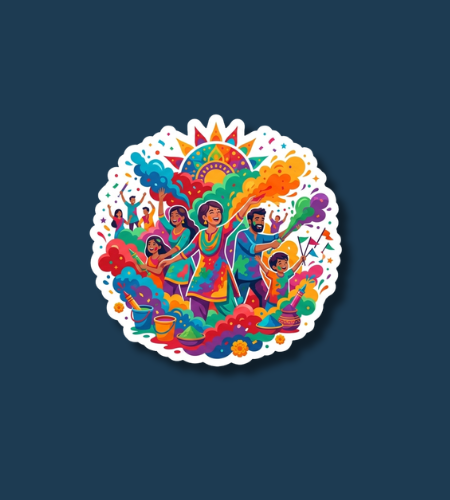
Holi is celebrated on the last full moon day of the Hindu luni-solar calendar month of Phalguna, a timing that usually coincides with the arrival of spring. Known globally as the Festival of Colors, this vibrant Hindu holiday signifies the end of winter, the victory of good over evil, and the opportunity to mend broken relationships. In 2026, the main festivities of Rangwali Holi take place on March 4, following the evening bonfires of Holika Dahan on March 3.
Table of Contents
History of Holi
The roots of the festival are found in ancient Hindu mythology, primarily the legend of Prahlad and his demon father, King Hiranyakashipu. The king, granted a boon that made him nearly invincible, demanded universal worship, but his son Prahlad remained a devoted follower of Lord Vishnu. Enraged, the king tasked his sister Holika—who possessed a flame-resistant cloak—with sitting in a bonfire while holding Prahlad. However, the cloak protected the virtuous Prahlad while Holika was consumed by the flames, a moment now commemorated by the lighting of ritual bonfires.
Another historical layer of the festival stems from the divine love story of Radha and Krishna. Legend suggests that Krishna, self-conscious about his dark blue skin, was encouraged by his mother to playfully smear color on Radha’s face to bridge their differences. This charming act evolved into the tradition of applying colored powders, known as gulal, to friends and family. Over centuries, the festival has transcended its religious origins, appearing in the carvings of ancient temples and the records of Mughal emperors who celebrated it with royal grandeur.
Why is Holi important?
Holi acts as a powerful social leveler in a society historically defined by rigid hierarchies. For one day, barriers of caste, age, and gender are ignored as participants drench each other in pigments, making everyone equal under a coating of bright colors. This shared experience fosters a sense of community and national unity, providing a rare opportunity for individuals to shed their inhibitions and engage in pure, unbridled joy.
The festival also carries significant seasonal and psychological weight as a period of transition and renewal. It marks the start of the harvest season, celebrating the fertility of the land and the blossoming of nature after a cold winter. On a personal level, it is a time for “shuddhi” or purification, where the ritual fires are said to burn away the negativity and ego of the past year. By encouraging people to forgive debts and forget old grudges, the holiday serves as an annual emotional reset.
- The celebration honors the triumph of devotion and truth over arrogance.
- It marks the official arrival of spring and the end of the winter season.
- Social divisions are temporarily suspended to promote universal brotherhood.
- The festival encourages the repair of strained friendships through forgiveness.
- It highlights the agricultural cycle and the hope for a successful harvest.
How to Celebrate Holi
The festivities begin on the eve of the main holiday with Holika Dahan, where communities gather to light massive bonfires. Participants often perform a “parikrama,” walking around the fire to symbolize the destruction of evil thoughts and the cleansing of the spirit. The following morning, the atmosphere shifts to a high-energy “color war” where people take to the streets equipped with bags of colored powder and pichkaris, or water guns, to drench anyone in sight.
Food plays a central role in the celebration, with specific traditional delicacies prepared to share with visitors. Gujiya, a sweet deep-fried dumpling stuffed with dried fruits and khoya, is the signature treat of the season. Many also enjoy thandai, a chilled milk drink flavored with saffron, almonds, and rose petals. After a day of intense play, families typically bathe, dress in clean clothes, and visit relatives in the evening to exchange dry sweets and warm embraces, cementing the bonds of the community.
- Light a ceremonial bonfire on the eve of the festival to symbolize renewal.
- Use organic colored powders to smear on the faces of friends and family.
- Engage in playful water fights using water balloons and traditional sprayers.
- Prepare and share traditional snacks like gujiya and malpua with neighbors.
- Host a gathering with music and dancing to welcome the spirit of spring.
Subscribe to our newsletter and never miss a holiday again!