
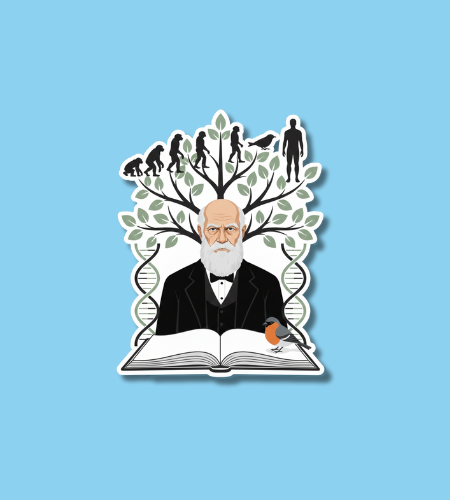
International Darwin Day is observed on February 12. This day commemorates the birth of Charles Darwin in 1809 and serves as a global celebration of science, humanity, and the natural world. It encourages people to explore the wonders of evolutionary biology and the rigorous scientific methods that help us understand the origins of life on Earth.
Table of Contents
History of International Darwin Day
The roots of this celebration trace back to the early 20th century. Following Darwin’s death in 1882, the scientific community sought ways to honor his legacy. Significant events occurred in 1909, the centennial of his birth, when large-scale commemorations were held at the American Museum of Natural History and the University of Cambridge. These early gatherings focused on the impact of his 1859 book, On the Origin of Species, which introduced the concept of natural selection to the public.
Modern Darwin Day as a formalized international event began in the 1990s. In 1995, the Humanist Community of Palo Alto, California, organized one of the first specifically branded Darwin Day celebrations. Shortly after, the International Darwin Day Foundation was established to promote the holiday globally. Today, it is recognized by academic institutions, museums, and secular organizations in dozens of countries, functioning as a yearly reminder of the importance of intellectual bravery and scientific inquiry. 1
Why is International Darwin Day important?
This holiday highlights the fundamental role of science in modern society. By focusing on the theory of evolution, the day reinforces the idea that all living things are connected through a shared biological history. It provides a platform for educators and scientists to share new discoveries and explain how evidence-based research leads to a better understanding of our world.
Beyond biology, the day represents the value of curiosity and the pursuit of truth. It honors the courage required to challenge established beliefs with observable evidence. By celebrating Darwin’s life, the holiday encourages a general appreciation for the scientific method, which remains the primary tool for solving global challenges in medicine, agriculture, and conservation.
- It acknowledges the birthday of one of history’s most influential naturalists.
- The day promotes the teaching of evolution in schools and universities.
- It highlights the connection between all species on the planet.
- People use the occasion to advocate for the protection of biodiversity.
- It serves as a reminder of the power of rational thinking.
How to Celebrate International Darwin Day
Many people celebrate by visiting natural history museums or science centers. These institutions often host special exhibits, lectures, or film screenings that explain natural selection and common descent. Families often use the day to go on nature hikes, identifying local plants and animals to see biological diversity in action. Reading about Darwin’s five-year voyage on the HMS Beagle is another popular way to mark the occasion.
A unique tradition for this holiday is the Phylum Feast. During this meal, participants try to include ingredients from as many different branches of the tree of life as possible. This might involve serving various seafoods, plants, and fungi to appreciate the vast variety of organisms that have evolved over millions of years. It is a lighthearted way to bring scientific concepts to the dinner table while enjoying a meal with friends.
- Visit a local zoo or botanical garden to observe different species.
- Host a dinner party featuring foods from diverse biological groups.
- Read a biography about Charles Darwin or his scientific journals.
- Attend a public lecture at a nearby university or museum.
- Watch a documentary about the Galapagos Islands and their wildlife.
International Darwin Day Dates Table
| Year | Date | Day |
|---|---|---|
| 2026 | February 12 | Thursday |
| 2027 | February 12 | Friday |
| 2028 | February 12 | Saturday |
| 2029 | February 12 | Monday |
| 2030 | February 12 | Tuesday |
Subscribe to our newsletter and never miss a holiday again!