
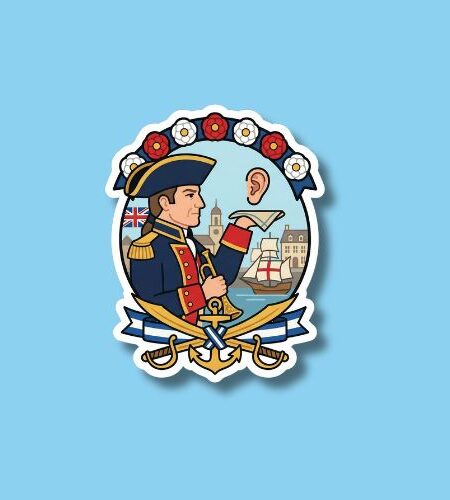
Jenkins Ear Day is observed on April 9. This day marks the anniversary of a bizarre 18th-century maritime incident that eventually served as a catalyst for a major conflict between Great Britain and Spain. It centers on the story of Captain Robert Jenkins, whose severed ear became a symbol of national outrage and political maneuvering.
Read also about National Former Prisoner of War Recognition Day
Table of Contents
History of Jenkins Ear Day
The event that defined this day occurred on April 9, 1731, when the British brig Rebecca was boarded by the Spanish coast guard near Havana, Cuba. The Spanish commander, Juan de León Fandiño, accused Captain Robert Jenkins of smuggling sugar and contraband. During the confrontation, Fandiño reportedly cut off Jenkins’ left ear with a cutlass and told him to present it to King George II as a warning. Jenkins allegedly preserved the ear in a jar of spirits and returned to England, though the incident initially received very little public or political attention.
Seven years later, in 1738, British merchants and politicians who favored a war with Spain revived the story to stir up public sentiment. Jenkins was summoned to testify before the House of Commons, where he purportedly displayed his pickled ear to the astonished members of Parliament. This dramatic presentation provided the emotional spark needed for Britain to declare war on Spain in 1739. The ensuing conflict, known as the War of Jenkins’ Ear, eventually merged into the larger War of the Austrian Succession and lasted until 1748.
Why is Jenkins Ear Day important?
This day serves as a historical case study on how individual incidents can be leveraged for broad political and military goals. It highlights the tension between colonial powers in the 18th century over trade routes and maritime sovereignty. The shriveled ear of a merchant captain became a powerful propaganda tool, demonstrating that public emotion is often as influential in starting wars as economic or territorial disputes. It reminds historians and students alike of the “asiento” contract and the complex trade laws that governed the Atlantic.
Beyond the geopolitical implications, the day focuses on maritime history and the harsh realities of life at sea during the Age of Sail. It preserves the memory of a specific moment where maritime law, personal injury, and international diplomacy intersected. Studying this event helps clarify the transition from minor trade skirmishes to global warfare. It also honors the peculiar nature of historical naming, as the “War of Jenkins’ Ear” was not actually given its famous title until historian Thomas Carlyle coined it in 1858.
- The day documents a turning point in British and Spanish colonial relations.
- It illustrates the power of political propaganda in the 1700s.
- The incident led to a naval war that spanned the Caribbean and Atlantic.
- It highlights the role of the House of Commons in 18th-century foreign policy.
- The holiday preserves a unique and eccentric piece of British naval lore.
How to Observe Jenkins Ear Day
Observing this day involves exploring the history of the Royal Navy and the Spanish Empire during the mid-1700s. Reading about the Battle of Cartagena de Indias or the invasion of Georgia provides context for the war that followed the incident. Many people use this day to visit maritime museums or research the specific ships involved, such as the Rebecca. It is a time for factual reflection on the mercantilist policies that drove European nations to fight over Caribbean trade rights.
On a more lighthearted note, some choose to acknowledge the day by focusing on the physical senses, particularly hearing. This can involve attending a live musical performance or simply appreciating the health of one’s own ears. sharing the story of Captain Jenkins with others is a common way to keep the quirky historical record alive. It provides an opportunity to discuss how modern diplomacy differs from the “gunboat diplomacy” and physical punishments that were common in the 1730s.
- Read historical accounts of the 1738 parliamentary testimony.
- Visit a naval museum to see 18th-century maritime artifacts.
- Listen to sea shanties or period-accurate orchestral music.
- Research the life of Captain Robert Jenkins after the war began.
- Share the story of the pickled ear to spark interest in history.
Jenkins Ear Day Dates Table
| Year | Date | Day |
|---|---|---|
| 2026 | April 9 | Thursday |
| 2027 | April 9 | Friday |
| 2028 | April 9 | Sunday |
| 2029 | April 9 | Monday |
| 2030 | April 9 | Tuesday |
Subscribe to our newsletter and never miss a holiday again!