
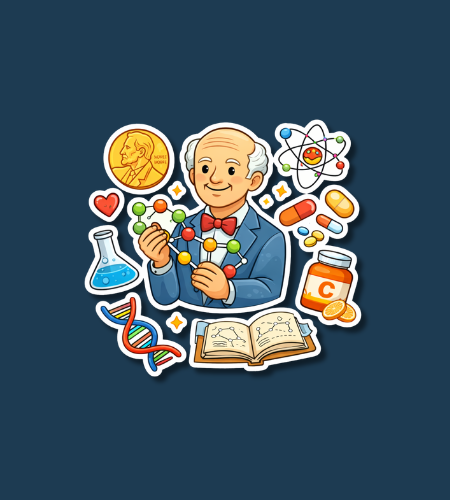
Linus Pauling Day is observed annually on February 28. This day commemorates the birth and legacy of Linus Pauling, a world-renowned scientist and peace activist who remains the only person to ever win two unshared Nobel Prizes. While the day has deep roots in the state of Oregon, where Pauling was born, it is recognized globally by the scientific community to celebrate advancements in chemistry, molecular biology, and humanitarian efforts.
Table of Contents
History of Linus Pauling Day
The establishment of this day followed the death of Linus Pauling in 1994 at the age of 93. To honor his lifelong contributions to science and global peace, the Governor of Oregon officially proclaimed February 28 as “Linus Carl Pauling Day.” The date was chosen specifically to coincide with his birthday, ensuring that his local heritage would be remembered alongside his international accolades. Oregon State University, Pauling’s alma mater, has since become a central hub for the holiday’s annual observances, housing his extensive archives and the institute that bears his name.
Over the years, the day has evolved from a local tribute into a broader celebration of scientific inquiry and ethical activism. Pauling’s career was marked by his 1954 Nobel Prize in Chemistry for his work on the nature of the chemical bond and his 1962 Nobel Peace Prize for his campaign against nuclear weapons testing. These dual achievements provide the historical framework for the day, highlighting how one individual’s work can bridge the gap between rigorous laboratory research and the pursuit of a safer world for humanity.
Why is Linus Pauling Day important?
This day serves as a reminder of the fundamental shifts Pauling brought to modern science, particularly in the fields of quantum chemistry and molecular biology. By applying quantum mechanics to chemistry, he provided the tools necessary for scientists to understand how atoms bond to form molecules. His research into the alpha helix and beta sheet was crucial for the eventual discovery of the DNA double helix. Celebrating this day ensures that these foundational concepts, which underpin much of current medical and biological research, are recognized and studied by new generations of students.
The holiday also emphasizes the importance of the “scientist-citizen” model. Pauling used his platform to advocate for the minimization of human suffering, often at great personal and professional cost during the Cold War era. His successful efforts to help secure the Partial Nuclear Test Ban Treaty in 1963 demonstrate the impact that data-driven advocacy can have on international policy. By observing this day, the public is encouraged to reflect on the ethical responsibilities of scientists and the power of peaceful protest in addressing global crises.
- It honors the only individual in history to receive two unshared Nobel Prizes.
- The day promotes interest in chemistry and the building blocks of molecular biology.
- It highlights the historical struggle for nuclear disarmament and global peace.
- The holiday encourages the public to learn about micronutrients and orthomolecular medicine.
- It recognizes the value of interdisciplinary research in solving complex human problems.
How to Observe Linus Pauling Day
One of the most popular ways to observe this day is through educational engagement with Pauling’s work. Many people spend time reading his seminal text, “The Nature of the Chemical Bond,” or exploring digital archives that document his correspondence and lab notebooks. Educational institutions often host guest lectures or “open house” events where researchers discuss modern developments in the fields Pauling pioneered. For those interested in his health advocacy, it is a common tradition to consume foods high in Vitamin C, such as oranges, as a nod to his later work on micronutrients.
In his home state, residents often visit sites associated with his life, such as his childhood home in Portland or the Linus Pauling Science Center in Corvallis. For those observing the day from a distance, participation often involves sharing scientific facts or peace-related quotes on social media to spread awareness of his humanitarian legacy. Some also choose to support organizations that work toward nuclear non-proliferation or medical research, directly continuing the causes that Pauling championed throughout his seven-decade career.
- Read a biography or watch a documentary about Pauling’s life and discoveries.
- Increase your intake of Vitamin C through fresh fruits or supplements.
- Visit a science museum or a university chemistry department.
- Participate in or donate to a local peace and disarmament initiative.
- Perform a simple chemistry experiment at home to explore molecular structures.
Linus Pauling Day Dates Table
| Year | Date | Day |
|---|---|---|
| 2026 | February 28 | Saturday |
| 2027 | February 28 | Sunday |
| 2028 | February 28 | Monday |
| 2029 | February 28 | Wednesday |
| 2030 | February 28 | Thursday |
Subscribe to our newsletter and never miss a holiday again!