
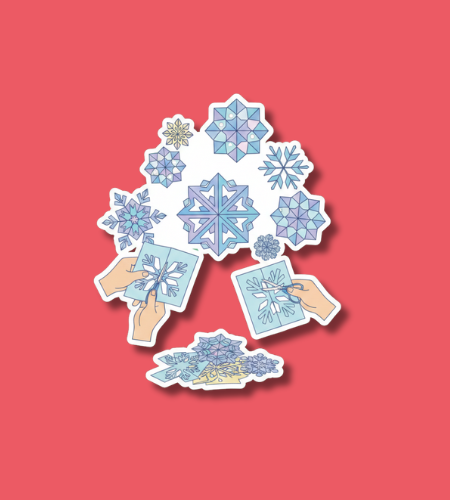
Make Cut-Out Snowflakes Day occurs every year on December 27. This day encourages people of all ages to pick up a pair of scissors and transform simple sheets of paper into intricate, symmetrical decorations that mimic the beauty of winter.
Table of Contents
History of Make Cut-Out Snowflakes Day
The origins of paper snowflake cutting are closely linked to the Japanese art of kirigami, which involves both folding and cutting paper to create three-dimensional designs. While paper folding dates back centuries, the specific tradition of cutting snowflakes became popular in the 19th century. In 1864, a woman named Frances Chickering published a book titled Cloud Crystals, which featured a collection of paper snowflake patterns she created after observing real snow crystals on her windowsill. This publication helped transition the activity from a casual past-time into a recognized form of seasonal art.
Throughout the early 20th century, the practice became a staple in Western education as a way to teach children about geometry and symmetry. The development of modern photography, specifically the work of Wilson Bentley who photographed thousands of real snowflakes, further fueled public interest in these designs. Today, the holiday serves as a designated time to slow down after the rush of Christmas and engage in a traditional craft that requires minimal supplies and maximum imagination.
Why is Make Cut-Out Snowflakes Day important?
The holiday emphasizes the value of creativity and the scientific principle that no two snowflakes are exactly alike. By engaging in this craft, individuals practice fine motor skills and spatial awareness as they visualize how a single cut will replicate across multiple folds. This provides a mental break from digital screens and encourages people to find joy in the process of making something by hand. It celebrates the unique structure of winter weather and allows those living in warmer climates to experience a version of a white Christmas.
Beyond its educational benefits, the day fosters a sense of community and shared family history. Many people remember learning to make snowflakes from parents or teachers, and passing this skill to the next generation preserves a low-cost cultural tradition. The temporary nature of paper art mirrors the fleeting beauty of real snow, teaching an appreciation for the present moment. Using recycled materials like old newspapers or wrapping paper also promotes a sustainable approach to seasonal home decoration.
- Creating paper art helps improve coordination and focus for both children and adults
- The process of unfolding the paper provides a small moment of surprise and discovery
- Homemade decorations offer a personal touch to living spaces during the winter months
- This activity requires only basic household items like paper and small scissors
- Learning about hexagonal symmetry connects art with natural science and meteorology
How to Celebrate Make Cut-Out Snowflakes Day
To participate, begin with a square piece of paper and fold it multiple times into a triangle. Use sharp scissors to snip small shapes such as triangles, circles, and crescents along the edges, making sure not to cut through the central folds entirely. Once the cutting is finished, carefully unfold the paper to reveal a symmetrical design. For a more authentic look, aim for a six-sided snowflake by using a specific folding technique that creates sixty-degree angles, reflecting the actual molecular structure of ice crystals.
Once the snowflakes are complete, they can be used in various decorative ways around the home. Many people tape them to windows to create the illusion of a frost-covered pane or string them together to make festive garlands for doorways. For a more advanced project, use different types of paper like coffee filters, tissue paper, or even metallic foil to vary the texture and shine. Sprinkling the finished cut-outs with glitter or painting them with light watercolors adds a personalized finish to each unique creation.
- Gather friends and family for a collaborative crafting session at the kitchen table
- Experiment with different folding angles to see how many points the flake develops
- Tape finished designs to window glass to catch the winter sunlight
- Use the paper cut-outs as unique coasters for holiday mugs or small gifts
- Watch a short video tutorial to master the six-point folding method
Make Cut-Out Snowflakes Day Dates Table
| Year | Date | Day |
|---|---|---|
| 2026 | December 27 | Sunday |
| 2027 | December 27 | Monday |
| 2028 | December 27 | Wednesday |
| 2029 | December 27 | Thursday |
| 2030 | December 27 | Friday |
Subscribe to our newsletter and never miss a holiday again!