
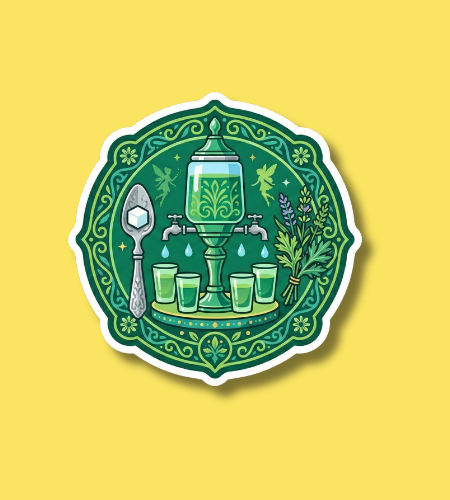
National Absinthe Day is observed on March 5 to celebrate the complex history and cultural revival of the high-proof spirit known as the Green Fairy. The holiday honors the anise-flavored botanical spirit that was famously banned in many countries for nearly a century due to unfounded health concerns and moral panic.
Table of Contents
History of National Absinthe Day
The history of absinthe began in the late 18th century in Switzerland, where it was initially developed by Dr. Pierre Ordinaire as a medicinal elixir. Its primary ingredients include grand wormwood, anise, and fennel, which give the spirit its distinctive licorice-like flavor and natural green hue. By the mid-19th century, absinthe became a staple of French café culture and a favorite among legendary artists and writers like Vincent van Gogh, Ernest Hemingway, and Oscar Wilde, who believed it fueled their creativity.
Despite its popularity, the spirit became a target of the temperance movement and the wine industry in the early 1900s. Critics claimed that the chemical compound thujone, found in wormwood, caused hallucinations, madness, and violent behavior. Following a high-profile murder in Switzerland in 1905 mistakenly attributed to the drink, it was banned in the United States in 1912 and in France by 1915. It was not until March 5, 2007, that the United States officially lifted its 95-year ban after modern science proved the spirit was no more dangerous than other types of alcohol. National Absinthe Day was established on this anniversary to mark the legal return of the drink to the American market.
Why is National Absinthe Day important?
This holiday is important because it represents the triumph of scientific evidence over historical misinformation and societal panic. For almost a hundred years, absinthe was demonized as a dangerous hallucinogen, a myth that modern researchers have thoroughly debunked. The day serves as a formal rehabilitation of the spirit’s reputation, allowing it to take its rightful place in the world of fine spirits and historical mixology. It acknowledges that the alleged psychoactive effects were largely the result of its exceptionally high alcohol content rather than its botanical ingredients.
Beyond the science, the day celebrates a significant era of artistic and literary heritage. Absinthe was the catalyst for the “Green Hour” in Paris, a social ritual that defined the Belle Époque. By observing this day, enthusiasts preserve the traditional methods of production and service that nearly vanished during the prohibition years. It also supports the modern craft distilling industry, which has worked meticulously to rediscover and produce authentic pre-ban recipes using traditional copper stills and high-quality herbs.
- The holiday marks the specific date in 2007 when the U.S. government reauthorized the sale of absinthe.
- It recognizes the cultural impact of the “Green Fairy” on 19th-century European art and literature.
- The day helps dispel lingering myths about the spirit causing hallucinations or permanent brain damage.
- It celebrates the botanical complexity of a spirit that is crafted without added sugar or artificial colors.
- Many classic cocktails, such as the Sazerac, rely on absinthe for their essential flavor profile.
How to Celebrate National Absinthe Day
The most traditional way to celebrate is by performing the French absinthe ritual. This involve placing a perforated slotted spoon over a glass of the spirit, resting a sugar cube on top, and slowly dripping ice-cold water over the sugar. As the water mixes with the botanicals, the liquid undergoes a transformation called “the louche,” turning from a clear emerald green to a milky, opalescent white. This process releases the essential oils of the herbs and makes the high-proof spirit more palatable for sipping.
For those who prefer mixed drinks, the day is an opportunity to enjoy historical cocktails that feature the spirit as a key ingredient. The Sazerac, born in New Orleans, or the “Death in the Afternoon,” invented by Ernest Hemingway, are classic choices that highlight the spirit’s versatility. Many cocktail bars host tasting events where experts explain the distillation process and the differences between French and Swiss styles. Regardless of the method, the focus is on responsible appreciation and learning about the spirit’s unique role in global drinking culture.
- Use a traditional slotted spoon and sugar cube to witness the opalescent louche effect.
- Mix a classic cocktail like a Corpse Reviver No. 2 or a traditional Absinthe Frappé.
- Visit a local bar that offers an authentic absinthe fountain service for a group experience.
- Read the biographies of famous absinthe drinkers like Edgar Allan Poe or Pablo Picasso.
- Host a small gathering to compare the flavors of different botanical blends from various distillers.
National Absinthe Day Dates Table
| Year | Date | Day |
|---|---|---|
| 2026 | March 5 | Thursday |
| 2027 | March 5 | Friday |
| 2028 | March 5 | Sunday |
| 2029 | March 5 | Monday |
| 2030 | March 5 | Tuesday |
Subscribe to our newsletter and never miss a holiday again!