
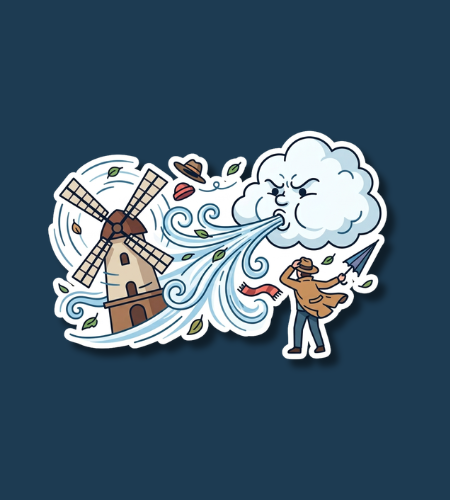
National Big Wind Day commemorates the anniversary of the highest natural wind speed ever recorded by human hands and is observed annually on April 12. This observance honors the scientific achievement of the Mount Washington Observatory team in New Hampshire and serves as a day for the public to learn about meteorology and the incredible power of the earth’s atmosphere.
Read also about Observe the Weather Day, National Weatherperson’s Day, World Meteorological Day
Table of Contents
History of National Big Wind Day
The event being honored took place on April 12, 1934, at the summit of Mount Washington. A three-man weather team consisting of Alex McKenzie, Salvatore Pagliuca, and Wendell Stephenson was stationed at the fledgling observatory during its second year of operation. While they expected a standard spring storm, the atmospheric pressure gradient tightened significantly across the White Mountains, leading to an extraordinary surge in wind velocity.
Using a heated anemometer specifically designed for the summit’s extreme conditions, the team measured a wind gust of 231 miles per hour. This speed set a world record that stood for 62 years until it was surpassed by an automated station during a 1996 cyclone in Australia. Despite the loss of the overall world title, the 1934 measurement remains the highest wind speed ever recorded at a staffed weather station, as the men had to repeatedly venture into the storm to de-ice their equipment manually to ensure accurate readings.
Why is National Big Wind Day important?
This day is important because it highlights the dedication of weather observers who live and work in extreme environments to provide accurate data. The 1934 record proved the viability of high-altitude weather research and established the Mount Washington Observatory as a premier site for studying severe weather patterns. It serves as a historical benchmark for meteorologists, illustrating how extreme natural events can occur even in regions that are not typically prone to tropical cyclones or tornadoes.
The observance also raises awareness about the advancements in meteorological technology since the 1930s. Comparing the hand-timed telegraph clicks used by the 1934 crew to modern digital sensors helps the public understand the evolution of climate science. Furthermore, it reminds people of the sheer physical force that wind can exert, fostering respect for natural elements and the importance of structural engineering in wind-prone areas.
- The record of 231 mph remains a landmark achievement in the history of New England.
- It recognizes the courage of researchers who perform duties in life-threatening conditions.
- The day promotes interest in STEM careers, particularly in the field of atmospheric science.
- It highlights the unique geography of Mount Washington, often called the “Home of the World’s Worst Weather.”
- The observance provides a platform for discussing renewable wind energy and its benefits.
How to Observe National Big Wind Day
Observing this day involves engaging with the history of the Mount Washington Observatory through its educational programs and archival materials. Many people celebrate by visiting the observatory’s museum or participating in virtual events that feature original logbooks and photos from the 1934 storm. Educators often use the day to teach students how to calculate wind speed and how pressure systems work to move air across the planet.
On a more recreational level, the day is an ideal time for wind-related outdoor activities like flying kites, sailing, or windsurfing. It is also common for weather enthusiasts to use portable anemometers to record local wind speeds and share their findings online to compare data from different regions. The atmosphere of the day is one of scientific curiosity and appreciation for the raw energy of the natural world.
- Visit a local science center or weather station to learn about anemometers.
- Fly a kite in a public park to experience the wind’s lift and drag.
- Read the firsthand accounts of the 1934 crew to understand the day’s intensity.
- Support wind power initiatives by learning about clean energy production.
- Measure the wind speed in your backyard and log the results for the day.
National Big Wind Day Dates Table
| Year | Date | Day |
|---|---|---|
| 2026 | April 12 | Sunday |
| 2027 | April 12 | Monday |
| 2028 | April 12 | Wednesday |
| 2029 | April 12 | Thursday |
| 2030 | April 12 | Friday |
Subscribe to our newsletter and never miss a holiday again!