
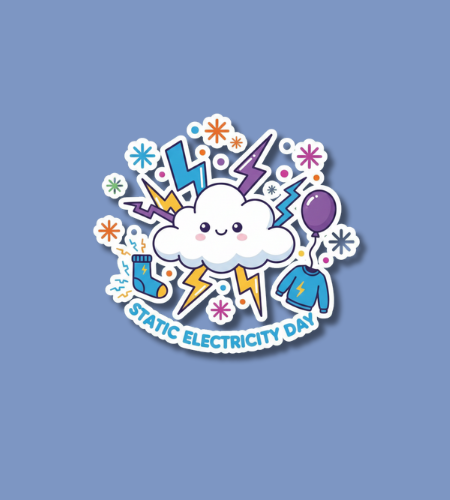
National Static Electricity Day is observed annually on January 9. This day focuses on the scientific phenomenon of static electricity, which occurs when there is an imbalance between positive and negative charges on the surface of an object. These charges remain stationary until they can move away by means of an electric discharge or current.
Table of Contents
History of National Static Electricity Day
The observation of static electricity dates back to 600 B.C. when the Greek philosopher Thales of Miletus noted that rubbing amber with a cloth caused the material to attract light particles like dust and feathers. Thales did not understand the atomic nature of the interaction, but his records represent the first documented instances of human interaction with electrical properties. It was centuries later that William Gilbert, an English scientist, coined the term “electricus” to describe this attractive force, distinguishing it from magnetism.
During the 18th century, Benjamin Franklin conducted his famous kite experiment to prove that lightning is a large-scale form of static discharge. This era saw significant progress in understanding how charges move between insulators and conductors. Modern scientists now utilize the Triboelectric Series to rank materials based on their tendency to gain or lose electrons. This scale explains why specific combinations, such as wool socks on a synthetic carpet, produce a noticeable shock when a person touches a metal doorknob.
Why is National Static Electricity Day important?
National Static Electricity Day highlights the practical role of physics in everyday safety and industrial efficiency. While a small spark from a finger might be a minor annoyance at home, static electricity poses significant risks in environments containing flammable gases or fine powders. Gas stations and chemical laboratories implement strict grounding protocols because a single discharge can ignite vapors. Understanding the conditions that foster static buildup, such as low humidity, allows professionals to design safer work environments through the use of anti-static flooring and specialized clothing.
Beyond safety, the principles of static electricity are essential for several modern technologies that simplify daily life. Photocopy machines and laser printers rely on static charges to attract toner particles to specific areas on a page. Air purification systems also use electrostatic precipitators to pull dust and smoke out of the air, improving indoor air quality. By observing this day, people gain a better understanding of how invisible forces contribute to both common household occurrences and complex mechanical systems.
- It identifies the risks of static discharge in industrial settings
- It explains why shocks are more frequent in dry winter weather
- It demonstrates the fundamental laws of atomic attraction and repulsion
- It highlights the technology behind everyday office equipment
- It encourages the use of preventative measures like humidifiers
How to Observe National Static Electricity Day
Observing this day often involves conducting simple science experiments that demonstrate how electrons transfer between objects. One of the most common methods is rubbing a latex balloon against hair or a wool sweater to see how it then adheres to a wall or causes hair to stand on end. These activities provide a visual representation of how negative charges accumulate on the surface of the balloon. Schools and museums frequently use Van de Graaff generators on this day to create large, visible sparks that illustrate high-voltage static electricity in a controlled environment.
For those looking to reduce the effects of static in their homes, the day serves as a reminder to implement moisture-control strategies. Increasing the humidity in a room prevents the air from acting as a perfect insulator, which allows charges to dissipate more naturally. Using dryer sheets or liquid fabric softeners also helps by coating fabrics with a thin layer of conductive chemicals that prevent charge buildup. Practicing safe habits, such as touching the metal frame of a car before exiting, can also prevent the sudden discomfort of a discharge during the dry winter months.
- Rub a balloon on various fabrics to test their static potential
- Place a humidifier in the living room to decrease air resistance
- Apply moisturizer to skin to create a conductive barrier
- Use a metal key to touch doorknobs and discharge safely
- Watch educational videos explaining the Triboelectric Series
National Static Electricity Day Dates Table
| Year | Date | Day |
|---|---|---|
| 2026 | January 9 | Friday |
| 2027 | January 9 | Saturday |
| 2028 | January 9 | Sunday |
| 2029 | January 9 | Tuesday |
| 2030 | January 9 | Wednesday |
Subscribe to our newsletter and never miss a holiday again!