
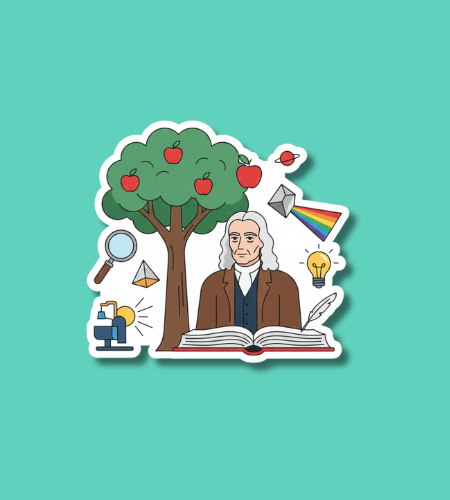
Newton’s Birthday (Newtonmas) is celebrated on January 4. While the physicist was born on Christmas Day under the Julian calendar used in 17th-century England, the modern Gregorian conversion places the anniversary on this date. This observance honors the legacy of Sir Isaac Newton and his monumental contributions to the laws of motion, gravity, and calculus.
Table of Contents
History of Newtonmas (Newton’s Birthday)
The tradition of honoring Newton’s birth on this specific date began in the late 19th century. In 1890, a group of students and professors at the Imperial University in Tokyo formed the Newton Association, also known as Newtonkai. They gathered on the anniversary of his birth to hear scientific lectures and exchange gifts, establishing the first recorded instance of a dedicated celebration for the physicist. These early gatherings focused on the joy of discovery and the importance of intellectual inquiry.
In the 20th and 21st centuries, the observance evolved into a broader cultural event known as Newtonmas or Grav-Mass Day. Prominent members of the scientific and skeptical communities popularized the holiday as an alternative or addition to traditional winter festivities. While the adoption of the Gregorian calendar moved Newton’s birth date to January 4 in modern records, the December 25 date is still widely preferred by participants. This allows science enthusiasts to participate in the global holiday season while focusing on the principles of logic and the scientific method.
Why is Newtonmas (Newton’s Birthday) important?
This day highlights the foundational role that Newton’s work plays in our understanding of the world. By formulating the laws of motion and universal gravitation, he provided a mathematical framework that explained everything from the movement of planets to the falling of an apple. Recognizing these achievements reminds society of the power of human reason to solve complex mysteries. It serves as an annual prompt to appreciate the scientific progress that makes modern technology and space exploration possible.
The holiday also promotes the value of curiosity and critical thinking across all generations. By focusing on a historical figure who excelled in physics, mathematics, and astronomy, the day encourages students to pursue interests in STEM fields. It creates a space for people of all backgrounds to celebrate shared human knowledge without the need for religious or supernatural context. Celebrating Newtonmas reinforces the idea that the laws of nature are universal and accessible to anyone willing to observe and calculate.
- It celebrates the birth of the person who discovered the laws of gravity.
- The day encourages people to value evidence and logical reasoning in daily life.
- It recognizes the invention of calculus as a vital tool for modern mathematics.
- The observance honors the development of the first practical reflecting telescope.
- It highlights the beauty of the natural world through the study of light and color.
How to Celebrate Newtonmas (Newton’s Birthday)
A common way to mark this day is by incorporating scientific themes into traditional holiday decorations. Many people hang apples on trees or around their homes to represent the famous story of the falling fruit that inspired Newton’s thoughts on gravity. Exchanging gifts that promote learning, such as science kits, telescopes, or biographies of famous researchers, is a popular practice among families. Hosting a dinner where guests discuss recent scientific breakthroughs or historical discoveries helps maintain the intellectual spirit of the event.
Creative activities like writing science-themed parodies of classic carols can add a lighthearted element to the celebration. Some observers take the opportunity to perform simple physics experiments at home, such as using a prism to split white light into a spectrum of colors. Eating apple-themed desserts like pie or cider is a frequent tradition that pays homage to the legendary apple tree at Woolsthorpe Manor. The goal is to spend time with others while acknowledging the profound impact that scientific inquiry has on human life.
- Decorate your living space with apples to honor the theory of universal gravitation.
- Give a science book or a laboratory kit to a curious friend or family member.
- Prepare an apple pie to share while discussing your favorite scientific facts.
- Use a prism to see how white light breaks into a rainbow of colors.
- Read a few pages from the Principia Mathematica to appreciate Newton’s original work.
Newtonmas (Newton’s Birthday) Dates Table
| Year | Date | Day |
|---|---|---|
| 2026 | January 4 | Sunday |
| 2027 | January 4 | Monday |
| 2028 | January 4 | Tuesday |
| 2029 | January 4 | Thursday |
| 2030 | January 4 | Friday |
Subscribe to our newsletter and never miss a holiday again!