
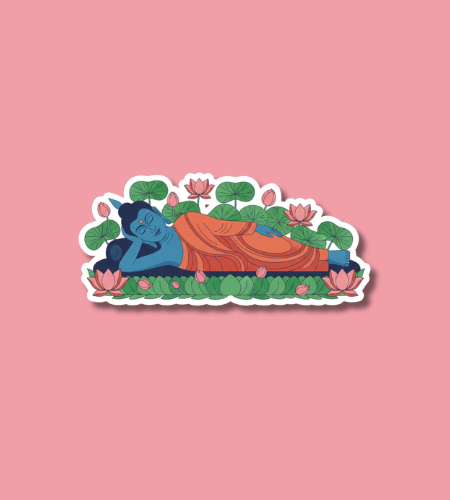
Parinirvana Day (Nirvana Day) is observed annually on February 15. This significant Buddhist festival commemorates the death of Gautama Buddha and his attainment of Parinirvana, a state of final liberation from the cycle of birth and death. While the passing of a teacher is often a somber occasion, the day is viewed as a celebration of the Buddha’s ultimate release from physical suffering and a time to reflect on the core teachings he left behind for his followers.
Table of Contents
History of Parinirvana Day (Nirvana Day)
The origins of this observance are found in the Mahaparinibbana Sutta, the Buddhist scripture that chronicles the final months and days of the Buddha’s life. According to tradition, the Buddha reached the age of 80 and realized his physical body was failing. He traveled to Kushinagar, where he lay down between two Sal trees. Before passing away, he provided final instructions to his disciples, famously telling them to “strive on with diligence” and to be their own lamps, seeking truth within themselves rather than relying on external authorities.
The concept of Parinirvana differs from the initial Nirvana the Buddha achieved under the Bodhi tree. While the first Nirvana was the awakening of his mind during his lifetime, Parinirvana is the “Nirvana after death,” occurring when an enlightened being dies and their physical existence ceases without being reborn. Over the centuries, this day became a central pillar of the Buddhist calendar, particularly in East Asian traditions like Mahayana Buddhism. It serves as a historical marker for the end of the Buddha’s earthly ministry and the transition of his teachings into a global spiritual legacy.
Why is Parinirvana Day (Nirvana Day) important?
This day is vital because it emphasizes the Buddhist doctrine of impermanence, or Anicca. By reflecting on the death of the Buddha himself, practitioners are reminded that all conditioned things, including life, must come to an end. This realization is not meant to be morbid but rather to inspire a sense of urgency in spiritual practice and a deeper appreciation for the present moment. It encourages followers to live mindfully and to focus on the things that truly matter, such as compassion, wisdom, and the pursuit of enlightenment.
The observance also reinforces the accessibility of the Buddha’s path. His passing demonstrated that he was a human being who faced the same physical limitations as everyone else, yet he managed to transcend suffering through his own efforts. This provides a source of immense hope and motivation for the faithful. Furthermore, the day is a time for the community to come together and express gratitude for the Triple Gem: the Buddha (the teacher), the Dharma (the teachings), and the Sangha (the community of practitioners).
- It highlights the central Buddhist teaching that all things are impermanent.
- The day provides an opportunity to reflect on one’s own mortality and life goals.
- It commemorates the final liberation of the Buddha from the cycle of rebirth.
- The occasion strengthens the bond between members of the Buddhist community.
- It serves as a reminder to practice the Dharma with renewed diligence and focus.
How to Observe Parinirvana Day (Nirvana Day)
Observation typically begins with a visit to a local temple or monastery for meditation and chanting. Many practitioners participate in retreats or study sessions where they read the Mahaparinibbana Sutta to contemplate the Buddha’s final words. It is a common tradition to bring offerings of food, flowers, and incense to the temple. In some cultures, particularly in Japan, it is customary to display scrolls or paintings of the “Nehan-zu,” which depict the Buddha lying on his side surrounded by grieving humans, animals, and celestial beings.
At home, many Buddhists observe the day through quiet reflection or by preparing traditional vegetarian meals to share with family. Some choose to spend the day in silence or engage in extra acts of “dana” (generosity), such as donating to charities or helping those in need, as a way to generate merit. Because the Buddha’s death occurred in a forest, some communities organize nature walks or outdoor meditations to feel a closer connection to the environment where the event took place. The day is characterized by a calm, contemplative energy focused on peace and spiritual resolve.
- Attend a meditation session at a temple to reflect on impermanence.
- Read the scriptures describing the Buddha’s final journey and instructions.
- Bring offerings of candles or flowers to a local Buddhist shrine.
- Prepare a simple vegetarian meal and share it with loved ones.
- Dedicate a period of time to silent reflection or mindfulness practice.
Parinirvana Day (Nirvana Day) Dates Table
| Year | Date | Day |
|---|---|---|
| 2026 | February 15 | Sunday |
| 2027 | February 15 | Monday |
| 2028 | February 15 | Tuesday |
| 2029 | February 15 | Thursday |
| 2030 | February 15 | Friday |
Subscribe to our newsletter and never miss a holiday again!