
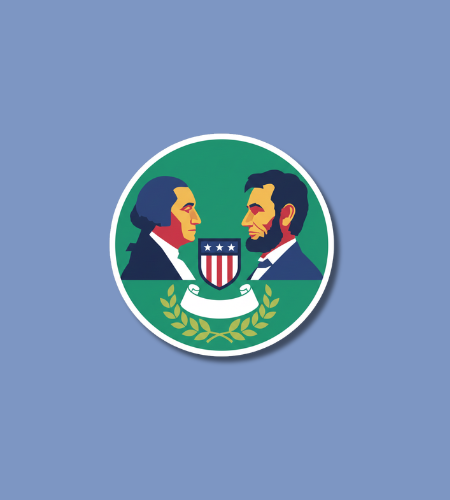
Presidents’ Day is observed on the third Monday of February. In 2026, it falls on February 16. While the holiday is widely known as Presidents’ Day to celebrate all who have held the office, its official name at the federal level remains Washington’s Birthday.
Read also about Lincoln’s Birthday
Table of Contents
History of Presidents’ Day
The holiday originated in 1879 to honor George Washington, the first president of the United States. Originally celebrated on his actual birthday, February 22, it was the first federal holiday to recognize an individual American. In 1885, the observance was expanded from government offices in Washington, D.C., to include all federal employees nationwide. For nearly a century, the holiday remained a fixed celebration of the “Father of his Country,” often marked by patriotic speeches and public ceremonies.
The shift toward the modern “Presidents’ Day” began with the Uniform Monday Holiday Act of 1968. This law sought to provide more three-day weekends for workers by moving several holidays to predetermined Mondays. When the change took effect in 1971, Washington’s Birthday was moved to the third Monday of February. Because this date falls between the birthdays of George Washington (February 22) and Abraham Lincoln (February 12), the public and the retail industry began using the term Presidents’ Day to honor both leaders, and eventually, all American presidents.
Why is Presidents’ Day important?
Presidents’ Day serves as a moment for the nation to reflect on the nature of executive leadership and the evolution of the American republic. It provides a formal opportunity to study the historical contributions of figures like George Washington, who set the precedent for a peaceful transition of power, and Abraham Lincoln, who preserved the Union during the Civil War. By celebrating the presidency as an institution, the holiday encourages citizens to evaluate the diverse challenges faced by leaders throughout different eras of American history.
The day is also significant for its role in civic education and national unity. Many schools and cultural institutions use the holiday to teach students about the Constitution and the responsibilities of the executive branch. In a modern context, the day has also become a major economic driver. As one of the first long weekends of the calendar year, it is a peak period for the travel and retail industries, with businesses offering promotions that have become a standard part of the holiday’s cultural footprint.
- It is the only federal holiday dedicated specifically to the office of the presidency.
- The holiday officially commemorates George Washington’s role as the nation’s founder.
- It bridges the gap between mid-winter and the beginning of spring.
- The day honors the collective achievements of all 46 American presidents.
- It provides a three-day weekend that boosts domestic travel and consumer spending.
How to Observe Presidents’ Day
Observing Presidents’ Day often involves visiting historic sites and landmarks associated with past leaders. Many people travel to Mount Vernon, Washington’s estate in Virginia, or the Lincoln Memorial in Washington, D.C., where special reenactments and tours are held. In the U.S. Senate, a long-standing tradition continues where a senator reads George Washington’s Farewell Address aloud to the chamber. This reading serves as a reminder of Washington’s warnings against political factionalism and foreign entanglements.
For those celebrating at home, the day is frequently marked by participating in community festivals or taking advantage of holiday sales. Families may engage in “presidential trivia” or read biographies of famous leaders to learn about the personal lives of those who lived in the White House. Since many public services are closed, it is also a popular day for outdoor recreation or short family trips. Many national parks offer free admission during the holiday weekend, encouraging citizens to explore the natural heritage preserved under various presidential administrations.
- Visit a presidential library or museum to view historical documents and artifacts.
- Attend a public reading of Washington’s Farewell Address or the Gettysburg Address.
- Take a trip to a national park or a historic battlefield preserved by the government.
- Spend time learning about the presidents featured on American currency and coins.
- Participate in a local parade or community event honoring American history.
Presidents’ Day Dates Table
| Year | Date | Day |
|---|---|---|
| 2026 | February 16 | Monday |
| 2027 | February 15 | Monday |
| 2028 | February 21 | Monday |
| 2029 | February 19 | Monday |
| 2030 | February 18 | Monday |
Subscribe to our newsletter and never miss a holiday again!