




Ruma: Ancient Stone Logic in a New Puzzle
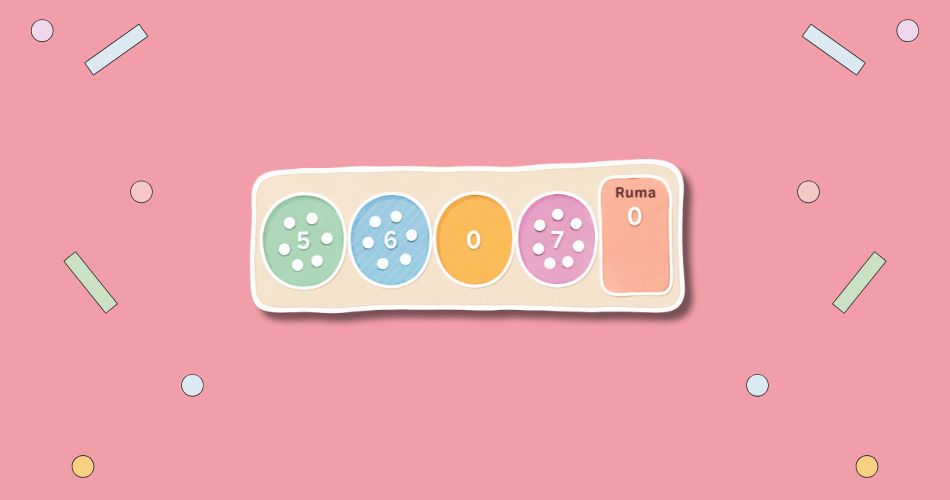
Some games don’t need complex rules or a lot of pieces. A few pits and a handful of stones are enough: pick them up from one pit and drop them one by one into the next. That simple idea gave rise to the mancala family—one of the oldest and most fascinating traditions in board game history.
Contents
Our new game, Ruma, grows out of that tradition. It’s all about moving stones, where every decision matters and a mistake at the beginning might only reveal itself at the very end—when it’s too late to finish the game. But this isn’t a direct copy of any historical version. It’s an original adaptation created specifically for pzl.app: modern, visually clean, meditative, and just tricky enough to keep your brain engaged.
From Mancala to a Mathematical Puzzle
From ancient board games and mathematical recreations to crosswords, Sudoku, jigsaws, and modern digital brain games, people have always enjoyed testing their logic, memory, attention, and patience through small, self-contained problems.
Daily Puzzles
Regular puzzle-solving can engage multiple cognitive abilities, including concentration, visual-spatial thinking, working memory, and problem-solving. It is not magic, of course—but a good puzzle gives the brain exactly what it likes: a clear goal, a manageable challenge, and the satisfying feeling of finding order in complexity.
The popularity of puzzles is also reflected in the number of special days dedicated to them, including:
- International Sudoku Day
- National Puzzle Day
- National Train Your Brain Day
- National Crossword Puzzle Day
Mancala
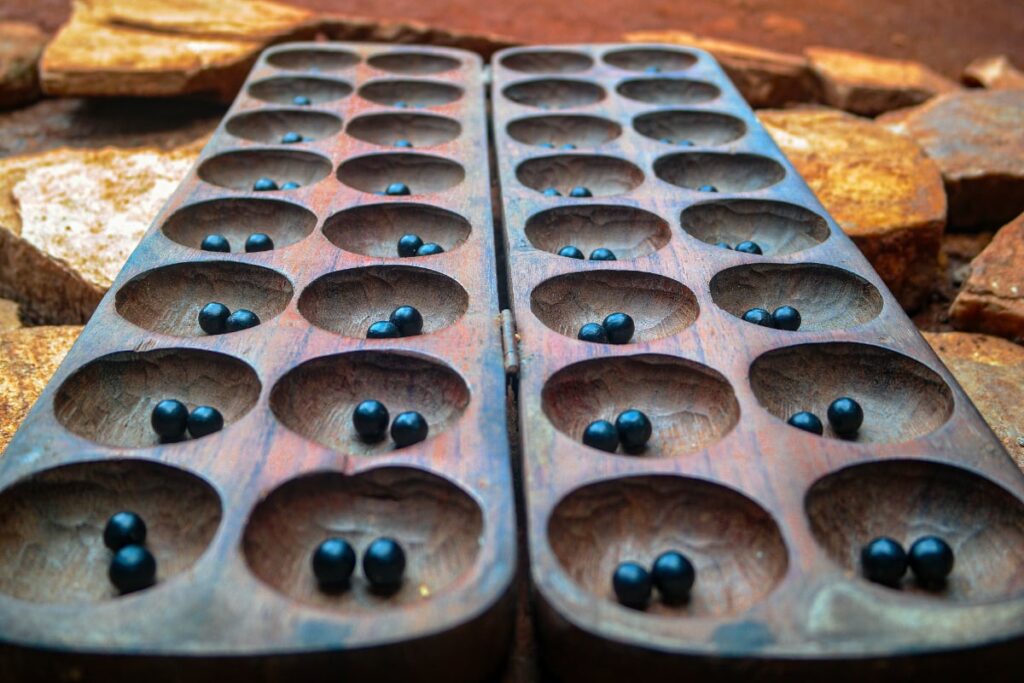
Mancala isn’t a single game but a broad family, most commonly found across Africa, the Middle East, and Asia. Boards, names, and rules vary from culture to culture, but they often share one core idea: sowing.

International Sudoku Day
You pick up stones from one pit and distribute them one by one into the next. A single move reshapes the entire board. Stones shift from pit to pit, opening new possibilities, closing others, and setting off long chains of consequences.
Closely related to this tradition is the solo mathematical puzzle Tchuka Ruma Solitaire 1 2. Unlike most mancala games, there’s no opponent. The goal is simple and elegant: move all the stones into a special final pit—the Ruma.
But getting there is anything but straightforward.
How Ruma Works
At the heart of the game is a chain reaction mechanic. You choose a pit, pick up its stones, and sow them one by one into the next pits. If the last stone lands in an occupied pit, your move continues—you pick up those stones and keep going. This can create long, flowing chains of moves.

National Puzzle Day
But if the last stone lands in an empty pit, the move fails. That’s why Ruma isn’t about trial and error—it’s about anticipating where your first choice will lead.
There’s no randomness in solving the puzzle. Stones don’t fall by chance, the board doesn’t change unpredictably, and success doesn’t depend on luck. Everything comes down to logic, attention, and the ability to think several steps ahead.
That said, you can also play more casually, without planning every move. In that case, the puzzle starts to feel more like a solitaire experience—especially in “Free Play” mode, where a solution isn’t guaranteed.
What makes it special is how simple the rules remain. There are no complex combinations to memorize, no exceptions to learn. You just choose a pit.
Our Version: A New Adaptation
Ruma isn’t a replica of any traditional mancala game. We created our own version—an original adaptation designed to make the gameplay as engaging as possible.
We reimagined the rules to work naturally in a digital format, making the game easy to understand from the very first seconds while still offering real depth.
Carefully Designed Puzzles, Not Random Setups
One of the most important parts of our work is crafting well-designed positions.
In many puzzle games, you can simply place elements at random and call it a level. But that approach doesn’t work for Ruma. A position might look interesting but have no solution. Or it might be too obvious. Or it might contain a short, accidental path that breaks the intended challenge.
That’s why we carefully design each position to ensure it’s both engaging and solvable. As a result, the levels don’t feel random—they feel purposeful. You’re solving a real puzzle, not wandering through chaos.
For those who prefer experimentation, there’s “Free Play.” Here, you can explore positions without guaranteed solutions—just like in the past, when stones were scattered freely and the challenge was to figure out whether a solution existed at all, and what sequence of moves would lead to it.
Ruma is perfect for players who enjoy puzzles without randomness. There’s no waiting for luck. If a position has a solution, you can find it through logic. If a move fails, it’s not a punishment—it’s a clue that somewhere along the chain, there was a better path.
We created Ruma as a puzzle with its own character: simple, calm, and deeply logical.
Pick up the stones from the first pit. Watch where the chain leads. And try to find the path where every stone eventually reaches the Ruma.