
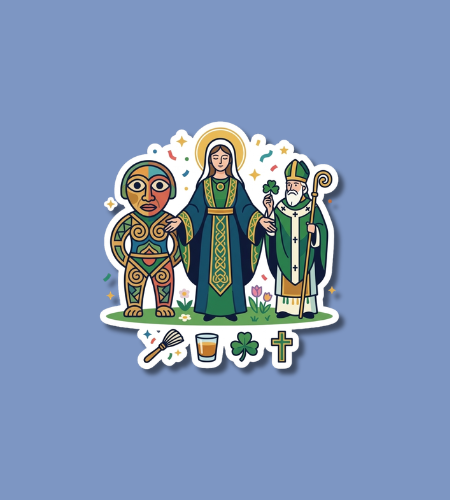
Sheelah’s Day is observed annually on March 18 to honor the figure in Irish folklore often identified as the wife or mother of Saint Patrick. Historically, this cultural holiday served as a spirited extension of Saint Patrick’s Day, transforming the festivities into a multi-day celebration that recognized both the male and female aspects of Irish spirituality and identity. While the day was once a major fixture in the Irish social calendar, particularly in the 18th and 19th centuries, it is now primarily remembered in Newfoundland, Canada, and parts of Australia, where the traditions were carried by Irish immigrants.
Table of Contents
History of Sheelah’s Day
The origins of Sheelah’s Day are rooted in the oral traditions and folk beliefs of pre-Famine Ireland. While there is no mention of a wife in Saint Patrick’s own writings, such as his Confessio, 18th-century newspaper reports and journals frequently referenced “Sheelah’s Day” as a time to commemorate the saint’s “other half.” John Carr’s 1806 book, The Stranger in Ireland, documented that country people would continue their celebrations into March 18 specifically to honor Sheelagh, highlighting a cultural desire to pair the patron saint with a female counterpart.
As Irish populations migrated, they brought the legend of Sheelah across the Atlantic and to the Southern Hemisphere. In Newfoundland, the tradition evolved into the weather lore of “Sheelah’s Brush,” a late-season snowstorm believed to be Sheelah sweeping away the last of winter. In Australia, the popularity of the name Sheelah among early Irish settlers is often cited as the linguistic root for the common slang term “sheila” used for a woman. Despite its decline in Ireland after the mid-1800s, the day remains a subject of modern interest for its links to the ancient “Sheela-na-gig” stone carvings and the celebration of the divine feminine.
Why is Sheelah’s Day important?
This day is significant for its role in preserving the “duality” of Irish mythology, where female figures like Sheelah, Brigid, and the Cailleach represent the life-giving and transformative powers of nature. By celebrating Sheelah immediately following Patrick, the traditional calendar acknowledged that spring renewal and fertility were just as essential to the nation’s identity as religious conversion. It provided a space for women to take a more central role in community festivities, ensuring that the female perspective was not entirely overshadowed by the formal church celebrations of the previous day.
The survival of Sheelah’s Day in the Irish diaspora demonstrates the resilience of folk traditions and their ability to adapt to new environments. For descendants of Irish immigrants, the day serves as a unique link to their ancestral past that distinguishes their heritage from the more commercialized versions of Saint Patrick’s Day. It reinforces a connection to the natural world, particularly through the lens of seasonal transitions and the folklore that explains the unpredictable weather patterns of early spring.
- It honors the female figures of Irish folklore who represent nature and renewal.
- The day serves as a historical reminder of how Irish traditions were once three-day festivals.
- It provides a cultural context for linguistic terms and weather lore in Canada and Australia.
- Celebrating Sheelah helps balance the historical narrative of early Irish Christianity.
- The observance highlights the importance of folk belief in shaping national identity.
How to Celebrate Sheelah’s Day
Observing Sheelah’s Day traditionally involves extending the festive atmosphere of the previous day by continuing to wear green and shamrocks. A central custom is the “drowning of the shamrock,” where the sprig of clover worn during the festivities is placed into a final glass of Irish whiskey or ale and consumed. This act symbolizes the end of the feast and the transition back to the standard routine of Lent, making the 18th a final moment of indulgence and social gathering.
In modern times, people celebrate by researching the history of Sheela-na-gigs or exploring the connections between Sheelah and the spring equinox. Many choose to mark the day by focusing on the contributions of women in their families and communities, reflecting on the “female cosmic agency” that folklorists associate with the figure of Sheelah. In Atlantic Canada, the day is often celebrated by watching for the “Sheelah’s Brush” snowstorm, using the weather event as a cue to share stories of the legendary Irish princess Sheila NaGeira and her influence on local history.
- Wear a fresh shamrock and “drown” it in a glass of whiskey at the end of the day.
- Research the locations of Sheela-na-gig stone carvings across Ireland and Europe.
- Cook a traditional Irish meal to share with friends who missed the Saint Patrick’s Day rush.
- Look for signs of “Sheelah’s Brush” in the weather forecast during mid-March.
- Share stories or poems that feature the name Síle or Sheelah to keep the folklore alive.
Sheelah’s Day Dates Table
| Year | Date | Day |
|---|---|---|
| 2026 | March 18 | Wednesday |
| 2027 | March 18 | Thursday |
| 2028 | March 18 | Saturday |
| 2029 | March 18 | Sunday |
| 2030 | March 18 | Monday |
Subscribe to our newsletter and never miss a holiday again!