
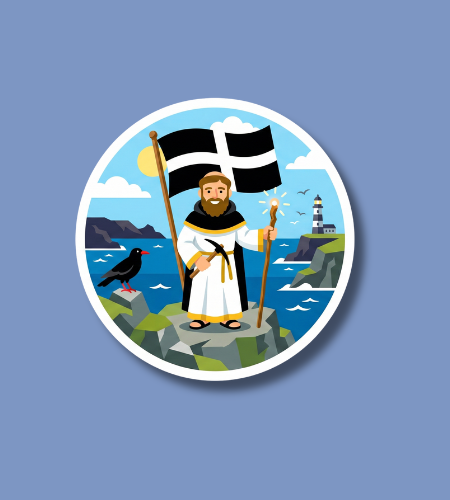
St. Piran’s Day is observed on March 5 as the national day of Cornwall, honoring the patron saint of tin miners and the region itself. The date marks the traditional feast day of Saint Piran, a 5th-century abbot who is credited with discovering tin and bringing Christianity to the Cornish people. Today, it serves as a major cultural celebration of Cornish identity, heritage, and the distinct Celtic history of the peninsula.
Table of Contents
History of St. Piran’s Day
The history of the holiday centers on the legend of Saint Piran, an Irish bishop who was cast into the sea tied to a millstone. According to the story, the stone floated miraculously, carrying him across the Celtic Sea to the shores of Perranporth in Cornwall. Once there, he built a small chapel in the sand dunes, known as an oratory, which remains one of the oldest Christian sites in Great Britain. Piran became famous for his discovery of tin when he noticed a white metal flowing from a black hearthstone in his fire, an event that laid the foundation for Cornwall’s primary industry for centuries.
While the feast day has religious origins, it was historically kept as a “tinner’s holiday” by the miners who viewed Piran as their guardian. During the 19th century, the celebration saw a decline as the mining industry faded, but it was revived in the late 1800s and early 1900s by Celtic revivalists. They adopted St. Piran’s flag—a white cross on a black background representing the white tin in the black ore—as the official flag of Cornwall. Since the 1950s, the day has evolved from a local parish fair into a county-wide festival of pride and community.
Why is St. Piran’s Day important?
St. Piran’s Day is the primary symbol of Cornish national identity and cultural distinctiveness within the United Kingdom. It provides an opportunity for people to celebrate their Celtic roots through music, language, and dance, ensuring that unique traditions are passed down to younger generations. The holiday reinforces a sense of belonging and pride in a region that has its own recognized minority status and a history of industrial innovation and maritime skill.
The importance of the day also lies in its ability to bring communities together through shared history and local commerce. By focusing on traditional foods, local crafts, and regional songs, the festivities support the local economy and keep the “Cornish spirit” alive. For many, the day is an assertion of the region’s resilience, honoring the hardworking miners and laborers of the past while looking forward to a vibrant future. It is a time when the black and white flag is flown from almost every building, signaling a unified cultural front.
- The holiday honors the patron saint who provided the secret to tin smelting.
- It serves as a focal point for the preservation of the Cornish language.
- The day marks the unofficial start of spring for many local residents.
- It celebrates the historical contribution of Cornish miners to the global economy.
- The event fosters community unity through large-scale public processions and singing.
How to Celebrate St. Piran’s Day
Celebrating the day often involves attending a local parade, where participants dress in black, white, and gold and carry the St. Piran flag. One of the most famous events is the pilgrimage across the dunes at Perranporth to the site of the ancient oratory, where performers re-enact the life of the saint. Many towns host “Furry Dances” through the streets, accompanied by brass bands and school children. It is also common for people to gather in pubs for the “Trelawny Shout,” a coordinated sing-along of the Cornish national anthem at exactly 9:00 PM.
Food plays a central role in the observation, with the Cornish pasty being the most iconic dish of the day. Families and bakeries prepare these savory treats along with saffron buns, heavy cake, and Cornish fairings. In schools, children learn about the legend of the floating millstone and practice traditional dances. Whether through a quiet meal at home or a loud community festival, the focus remains on expressing love for the Cornish landscape and its people.
- Attend a local procession or parade in towns like Truro, Penzance, or Bodmin.
- Join in a community sing-along of “The Song of the Western Men” at a local pub.
- Bake or buy a traditional Cornish pasty to enjoy for lunch or dinner.
- Display the black and white flag of St. Piran outside your home or business.
- Walk the coastal path to Perranporth to visit the remains of the ancient sand-buried oratory.
St. Piran’s Day Dates Table
| Year | Date | Day |
|---|---|---|
| 2026 | March 5 | Thursday |
| 2027 | March 5 | Friday |
| 2028 | March 5 | Sunday |
| 2029 | March 5 | Monday |
| 2030 | March 5 | Tuesday |
Subscribe to our newsletter and never miss a holiday again!