
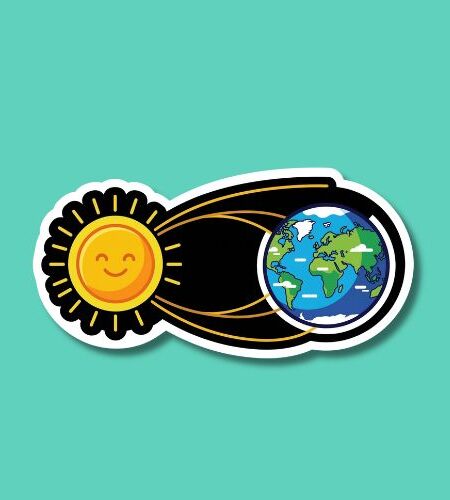
Sun-Earth Day is a flexible observance generally held near the spring equinox in the Northern Hemisphere. In 2026, it falls on March 20. This day is a joint educational initiative that focuses on the complex relationship between the sun and our planet, exploring how solar activity influences everything from the Earth’s weather patterns to its magnetic field and satellite communications.
Read also about Earth at Perihelion and Earth Overshoot Day
Table of Contents
History of Sun-Earth Day
Sun-Earth Day was established in 2000 through a collaborative effort between NASA and the European Space Agency (ESA). The program was designed to bridge the gap between complex space science and the public, specifically targeting students and educators. By timing the event around the spring equinox—a moment when the sun crosses the celestial equator and day and night are approximately equal—the organizations provided a tangible, global reference point for astronomical study. 1
For more than two decades, the program has evolved to include specific annual themes that highlight various aspects of solar science. Past themes have focused on solar eclipses, the aurora borealis, and ancient observatories that tracked the sun’s movement centuries ago. These efforts have successfully integrated real-time satellite data from missions like the Solar and Heliospheric Observatory (SOHO) into classroom curricula, allowing people to see the sun as a dynamic, changing star rather than a static light in the sky.
Why is Sun-Earth Day important?
The primary importance of this day lies in its ability to demystify the science of space weather. While many people view the sun solely as a source of light and heat, Sun-Earth Day highlights the “invisible” connections, such as solar flares and coronal mass ejections. Understanding these phenomena is critical for modern society, as intense solar activity can disrupt power grids, interfere with GPS signals, and impact the safety of astronauts currently in orbit.
Furthermore, the day emphasizes the Earth’s unique position in the solar system. It serves as a reminder of the protective role played by our atmosphere and magnetic field, which shield the surface from harmful solar radiation. By fostering an interest in heliophysics—the study of the sun and its effects on the solar system—the event inspires the next generation of scientists and engineers to develop technologies that can better predict and mitigate the effects of solar storms on our digital infrastructure.
- It educates the public on how solar activity impacts technology and communication.
- The day promotes the use of real-time satellite imagery in science education.
- It highlights the astronomical significance of the spring equinox.
- The observance fosters international cooperation between space agencies.
- It raises awareness about the importance of the Earth’s magnetic protection.
How to Observe Sun-Earth Day
Observing Sun-Earth Day often involves participating in organized educational webcasts or local planetarium events. Many people use this time to view the sun safely through specialized solar telescopes or pinhole projectors, which allow for the observation of sunspots without damaging the eyes. Schools and science centers frequently host “star parties” or solar viewing sessions where experts explain the lifecycle of a star and the mechanics of the solar wind.
For those celebrating at home, the day is an excellent opportunity to engage with digital resources provided by NASA and ESA. You can explore interactive maps of the solar system or track current aurora activity online to see where the sun’s energy is interacting with the atmosphere. Simple experiments, such as tracking the length of shadows throughout the day or using a prism to split sunlight into a spectrum, provide hands-on ways to appreciate the physics of our closest star.
- Use a solar-safe telescope to observe sunspots or solar prominences.
- Participate in a NASA or ESA live-streamed educational event.
- Track the movement of shadows to mark the arrival of the equinox.
- Visit a local science museum or planetarium for a special sun-themed show.
- Check online aurora forecasts to see the visual effects of solar particles.
Sun-Earth Day Dates Table
| Year | Date | Day |
|---|---|---|
| 2026 | March 1 | Sunday |
| 2027 | March 1 | Monday |
| 2028 | March 1 | Wednesday |
| 2029 | March 1 | Thursday |
| 2030 | March 1 | Friday |
Subscribe to our newsletter and never miss a holiday again!