
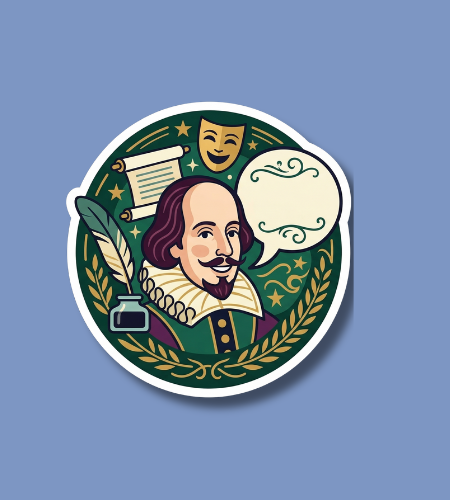
Talk Like William Shakespeare Day is a playful annual observance held on April 23 that invites people to celebrate the linguistic legacy of the world’s most famous playwright by adopting his signature Early Modern English style. The day coincides with the traditional anniversary of both the birth and death of the Bard of Avon, serving as a lively tribute to his 38 plays and 154 sonnets. By encouraging the use of archaic pronouns like “thou” and “thee,” as well as rhythmic iambic pentameter, the holiday aims to make Shakespeare’s seemingly complex language more accessible and fun for the public. It provides a unique opportunity for students, actors, and literature lovers to explore how the English language has evolved while acknowledging the thousands of words and phrases that Shakespeare personally introduced into common usage.
Read also about World Poetry Day
Table of Contents
History of Talk Like William Shakespeare Day
The holiday was officially established in 2009 by the Chicago Shakespeare Theater. The organization’s goal was to honor the playwright’s 445th birthday by encouraging residents to speak in “Shakespearian” throughout their daily routines. The initiative received significant support from local government, with then-Mayor Richard M. Daley issuing an official proclamation declaring the city a “Shakespeare-friendly” zone. The success of the Chicago event quickly caught the attention of the global theater community, leading to the holiday’s international adoption through social media and cultural institutions.
The choice of April 23 is historically significant as it is the feast day of Saint George, the patron saint of England, and is widely accepted by scholars as Shakespeare’s birthday. Although his exact birth date was not recorded, church records show he was baptized on April 26, 1564, and tradition has long held the 23rd as the anniversary. Since 2010, the United Nations has also recognized this date as English Language Day, further solidifying the connection between Shakespeare’s work and the development of the English tongue as a global tool for communication and artistic expression.
Why is Talk Like William Shakespeare Day important?
This day is vital because it highlights the massive impact William Shakespeare had on the standardization and expansion of the English language. He is credited with inventing or introducing over 1,700 words—including “lonely,” “gossip,” and “bedroom”—which are now essential parts of our daily vocabulary. By participating in the holiday, people become more aware of the linguistic roots of their own speech and the creative power of neologisms. It serves as an educational bridge that demystifies the “difficult” reputation of his plays, showing that his writing was originally intended for a wide, diverse audience rather than just the academic elite.
Beyond linguistics, the celebration preserves the cultural heritage of the Elizabethan and Jacobean eras. Shakespeare’s works are praised for their deep psychological insights and universal themes of love, power, and betrayal that remain relevant in the modern world. Celebrating his style of speech encourages a deeper appreciation for the rhythm and musicality of language, fostering creativity in how we communicate. The day also serves to support the arts and theater industries, reminding the public of the enduring value of live performance and classical literature in a digital age.
- Shakespeare introduced many common phrases like “heart of gold” and “wild goose chase.”
- The holiday encourages a better understanding of the rhythm of iambic pentameter.
- It helps students feel more comfortable with the texts they study in school.
- Celebrating his birthday promotes the importance of storytelling and dramatic arts.
- The day connects millions of people globally through a shared literary heritage.
How to Celebrate Talk Like William Shakespeare Day
To participate effectively, one should start by swapping modern pronouns for their older counterparts, using “thou” for “you” in the singular and “ye” for the plural. Adding suffixes like “-eth” to verbs, such as “he goeth” instead of “he goes,” can instantly give your speech a period-accurate feel. Many fans also enjoy using Shakespearean-style insults, which are known for being elaborate and creative without using modern profanity. Reading a sonnet aloud or memorizing a famous monologue, such as the “To be, or not to be” speech from Hamlet, is a popular way to honor the Bard’s specific genius.
For a more communal celebration, you can host a “Bard’s Birthday” party featuring traditional English recipes from the 16th century, such as small meat pies or spiced ale. Dressing in Elizabethan-inspired attire, like a simple paper ruff or a doublet, adds a visual element to the festivities. Many theaters and libraries host free screenings of filmed plays or organize public “sonnet slams” where anyone can step up to a microphone to perform. Digital celebrations are also common, with participants using social media to share their favorite quotes or videos of themselves performing daily tasks while speaking in verse.
- Replace the word “you” with “thou” or “thee” in your text messages.
- Use a Shakespearean insult generator to find a clever way to tease your friends.
- Watch a classic film adaptation of a play like Romeo and Juliet or Macbeth.
- Try to write a 14-line sonnet about a modern object like a smartphone.
- Visit a local library to browse through a copy of the First Folio or a modern edition.
Talk Like William Shakespeare Day Dates Table
| Year | Date | Day |
|---|---|---|
| 2026 | April 23 | Thursday |
| 2027 | April 23 | Friday |
| 2028 | April 23 | Sunday |
| 2029 | April 23 | Monday |
| 2030 | April 23 | Tuesday |
Subscribe to our newsletter and never miss a holiday again!