
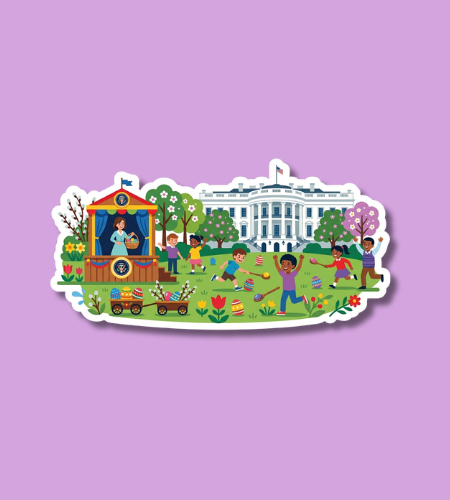
The White House Easter Egg Roll is observed on Easter Monday. In 2026, it falls on April 6. This historic event is the largest public celebration held at the President’s residence, inviting families to the South Lawn for a day of traditional games and festivities. It serves as a symbolic opening of the White House grounds to the public, continuing a tradition that has endured for nearly a century and a half.
Read also about Presidents’ Day
Table of Contents
History of the White House Easter Egg Roll
The tradition of rolling eggs on Easter Monday began as an informal public gathering on the grounds of the United States Capitol in the 1870s. However, the large crowds of children eventually caused significant damage to the Capitol’s terrace and landscaping. In response, Congress passed the Turf Protection Law in 1876, which banned the use of the Capitol grounds as a children’s playground. After rain canceled the 1877 festivities, a group of determined children approached the White House gates in 1878. President Rutherford B. Hayes instructed his guards to let them in, officially moving the celebration to the South Lawn.
Since its move to the White House, the event has evolved under the influence of various First Ladies and Presidents. President Benjamin Harrison introduced the United States Marine Band to the festivities in 1889, while First Lady Lou Hoover added folk dancing to the program. The event was suspended during World War I and World War II due to security concerns and food rationing, and it did not return until President Dwight D. Eisenhower reinstated it in 1953. In 1981, First Lady Nancy Reagan introduced the commemorative wooden eggs, which are now signed by the President and First Lady and given as keepsakes to all young participants.
Why is the White House Easter Egg Roll important?
The White House Easter Egg Roll is important because it represents the accessibility of the American government to its citizens. As the oldest continuous annual public event at the White House, it reinforces the idea that the Executive Mansion is the “People’s House.” The event provides a unique opportunity for thousands of families from all 50 states to interact with the First Family in a relaxed, celebratory environment, fostering a sense of national community and shared heritage.
In 2026, the event holds additional significance as it incorporates themes celebrating America’s 250th birthday. Beyond the fun of the games, the day promotes educational themes, including storytelling, physical fitness, and healthy eating. It also serves as a massive logistical feat, requiring the coordination of hundreds of volunteers and the support of the American Egg Board, which provides thousands of hard-boiled eggs for the races. By maintaining this tradition, the White House preserves a piece of Americana that bridges the gap between the nation’s past and its future generations.
- It commemorates the 1878 decision by President Hayes to open the South Lawn.
- The event highlights the role of the First Lady in shaping White House traditions.
- It features the famous egg roll race where children use spoons to push eggs.
- The day provides a platform for live entertainment, storytelling, and musical performances.
- It represents a rare moment of non-partisan, family-focused national unity.
How to Celebrate the White House Easter Egg Roll
The primary way to attend the official event is by entering the free online ticket lottery, which typically opens in late February or early March. Winners are selected from across the country, and each ticket allows a family to participate in a specific time slot on the South Lawn. Participants are encouraged to bring their energy for the main egg roll race, where children under 13 compete to reach a finish line while the President and First Lady often cheer from the sidelines.
For those who cannot travel to Washington, D.C., the spirit of the day can be celebrated at home by hosting a neighborhood egg roll. Using long-handled spoons and hard-boiled or wooden eggs, families can recreate the iconic races in their own backyards. Many people also observe the day by collecting the official wooden eggs, which are available for purchase through the White House Historical Association. Engaging in crafts like egg dyeing or reading stories about the history of the White House are also popular ways to honor the tradition.
- Enter the official ticket lottery on Recreation.gov several weeks before Easter.
- Organize a community egg roll race at a local park or in your backyard.
- Collect the official signed wooden egg as a commemorative keepsake.
- Watch the live broadcast or news coverage of the festivities on Easter Monday.
- Volunteer to help with the event’s logistics and guest management.
Subscribe to our newsletter and never miss a holiday again!