
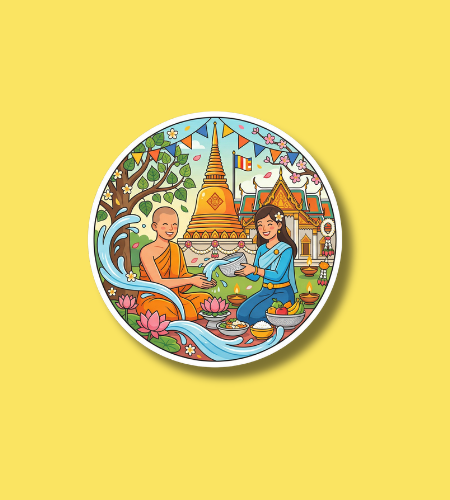
Theravada New Year is a major Buddhist festival celebrated by millions of people in Southeast Asia and parts of South Asia. It is observed for three days starting on the first full moon day in April. In 2026, the celebration begins on April 1, though local solar calendars (such as those in Thailand and Cambodia) often fix the observation to April 13–16. This holiday marks a time of spiritual renewal, merit-making, and joyful community gatherings.
Read also about Mahayana New Year, Chinese New Year, Aztec New Year, Orthodox New Year
Table of Contents
History of Theravada New Year
The roots of the Theravada New Year are deeply embedded in the agricultural and religious history of the Theravada school of Buddhism, which is the dominant form of the religion in Sri Lanka, Thailand, Cambodia, Laos, and Myanmar. While the specific legends vary by country—such as the story of the “New Angel” in Cambodia or the Songkran myths in Thailand—the festival is universally tied to the end of the harvest season and the beginning of the solar new year.
Historically, the timing was determined by the lunar calendar, coinciding with the sun’s entry into the constellation of Aries. In the mid-20th century, several nations standardized the dates to mid-April to provide consistency for modern administrative purposes. Despite these fixed dates, the core rituals remain centered on the Buddhist concept of “washing away” the misfortunes of the previous year to start fresh with a clean spirit and a focused mind.
Why is Theravada New Year Important?
This period is significant because it represents the “Great Sangkran” (transition), a time of deep spiritual cleansing and communal harmony. In Theravada tradition, it is believed that the actions performed during these days set the tone for the coming year. Therefore, people go to great lengths to perform acts of “Merit,” such as offering food to monks, releasing captive animals (like fish or birds), and performing acts of kindness for the elderly and less fortunate.
The celebration also serves as a vital cultural bridge. It is a time for “homecoming,” where urban workers return to their ancestral villages to pay respects to their parents and elders. This reinforces the Buddhist values of filial piety and gratitude. Furthermore, the public festivities—most notably the water-splashing rituals—act as a social equalizer, bringing people from all walks of life together in a shared experience of joy and refreshment during the hottest month of the year.
- It marks the transition to the new solar cycle and the arrival of the rains.
- The festival emphasizes the Buddhist practice of merit-making and charity.
- It preserves ancient traditional arts, including specific dances, music, and folk games.
- The ritual of “Bathing the Buddha” reinforces devotion and spiritual discipline.
- It promotes environmental awareness through the symbolic use of water as a life-giver.
How to Celebrate Theravada New Year
Celebrations typically begin with a visit to the local temple (Wat) in the morning. Devotees bring food and sweets to offer to the monks and participate in chanting and meditation. A central ritual is the “Bathing of the Buddha,” where scented water is poured over Buddha statues as a gesture of purification. People also build “Sand Stupas” on temple grounds, decorating them with colorful flags to gain merit and symbolize the transience of life.
Outside the temples, the celebration becomes much more exuberant. The practice of pouring water over the hands of elders as a sign of respect evolves into large-scale “water festivals” in the streets. People use buckets, water guns, and hoses to splash passersby, symbolizing the washing away of bad luck. In addition to water, traditional feasts featuring seasonal fruits and local delicacies are shared, and many communities host beauty pageants and parades featuring traditional costumes.
- Visit a local Buddhist temple to make offerings and receive blessings from monks.
- Gently pour scented water over the hands of parents or elders to show gratitude.
- Clean your home thoroughly to symbolically clear out the old year’s negativity.
- Participate in or observe a traditional parade featuring regional music and dance.
- Practice “Life Release” by freeing small animals back into their natural habitats.
Subscribe to our newsletter and never miss a holiday again!