
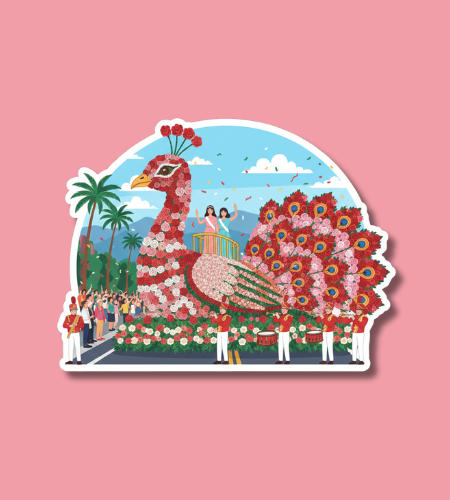
The Tournament of Roses Parade is observed on January 1st, unless that day falls on a Sunday, in which case it is held on January 2nd. This legendary floral procession takes place in Pasadena, California, and precedes the famous Rose Bowl college football game. Known for its massive, flower-covered floats, the event attracts hundreds of thousands of spectators to the streets of Pasadena and millions of viewers across the globe through television broadcasts.
Table of Contents
History of Tournament of Roses Parade
The event began in 1890 when members of Pasadena’s Valley Hunt Club wanted to showcase the mild winter climate of Southern California. While residents in the East and Midwest were dealing with snow and freezing temperatures, Californians enjoyed blooming flowers and ripening citrus. To celebrate this “Mediterranean of the West,” the club organized a festival featuring horse-drawn carriages decorated with thousands of fresh blooms. The initial festivities also included foot races, polo matches, and a tug-of-war, drawing a crowd of approximately 3,000 people.
As the parade grew in popularity, it became too large for the Valley Hunt Club to manage alone, leading to the formation of the Pasadena Tournament of Roses Association in 1895. The “Never on Sunday” rule was established in 1893 to avoid disturbing horses hitched outside local churches during Sunday services. Over the decades, the parade evolved from simple floral carriages to high-tech motorized floats equipped with complex animation. The first Rose Bowl Game was added in 1902 to help fund the rising costs of the parade, eventually becoming a permanent fixture of the New Year celebration in 1916.
Why is Tournament of Roses Parade important?
This parade serves as a global stage for artistic innovation and horticultural skill. Every square inch of the massive floats must be covered with natural materials such as flowers, seeds, bark, or leaves. This strict requirement challenges designers to find creative ways to use organic textures to build vibrant, lifelike scenes. The event also highlights the power of community service, as nearly 1,000 volunteers known as white suiters work year-round to organize the logistics, while thousands of others spend the final days of the year painstakingly applying individual petals to the floats.
Beyond the visuals, the parade is a prestigious platform for musical and equestrian talent. Marching bands from high schools, colleges, and international organizations spend years fundraising and practicing for the opportunity to march the 5.5-mile route. The inclusion of diverse equestrian units, ranging from historical reenactors to specialized horse breeds, honors the parade’s origins while showcasing various cultures. It acts as a unifying tradition that marks the transition into a new year with a focus on optimism and shared human achievement.
- The parade promotes the natural beauty and temperate climate of Southern California.
- It requires floats to be entirely covered in organic materials like petals and seeds.
- Volunteers contribute over 80,000 hours annually to ensure the event runs smoothly.
- It provides international exposure for talented marching bands and equestrian groups.
- The event maintains a historical tradition that has survived for over 130 years.
How to Celebrate Tournament of Roses Parade
Watching the parade in person requires early preparation, as many spectators camp out on the sidewalks of Colorado Boulevard the night before to secure a view. Those attending should dress in layers to stay warm during the chilly early morning hours before the California sun rises. If you prefer a seated experience, grandstand tickets are available but must be reserved well in advance. After the parade concludes, the floats are often moved to a designated area for a post-parade showcase where visitors can get a close-up look at the intricate floral details and take photos without the moving crowds.
For those celebrating from home, the parade is widely broadcast and offers a relaxed way to enjoy the spectacle. Many families make it a tradition to watch the floral designs and musical performances while preparing a New Year’s Day meal. You can also participate by volunteering for float decorating in the days leading up to the event, which offers a hands-on look at the engineering and artistry involved. Learning about the year’s specific theme and the background of the Grand Marshal can also add depth to the viewing experience.
- Arrive in Pasadena early or camp out overnight to find a prime viewing spot.
- Wear comfortable shoes and warm clothing to handle the 5.5-mile route or long wait.
- Attend the post-parade float fest to see the floral craftsmanship from a few feet away.
- Tune in to the live television broadcast to see the event from multiple camera angles.
- Research the float participants and themes to better appreciate the stories being told.
Tournament of Roses Parade Dates Table
| Year | Date | Day |
|---|---|---|
| 2026 | January 1 | Thursday |
| 2027 | January 1 | Friday |
| 2028 | January 1 | Saturday |
| 2029 | January 1 | Monday |
| 2030 | January 1 | Tuesday |
Subscribe to our newsletter and never miss a holiday again!