
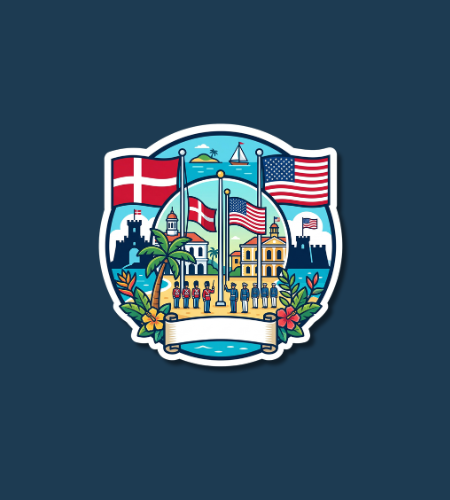
Transfer Day is observed on March 31 to commemorate the formal transition of the Virgin Islands from Danish to American sovereignty. This public holiday in the U.S. Virgin Islands marks the anniversary of the 1917 ceremony where the Danish West Indies were officially ceded to the United States. It serves as a day of reflection on the islands’ colonial history, their unique cultural blend, and the enduring social and political evolution of the territory.
Table of Contents
History of Transfer Day
The United States first expressed interest in the Danish West Indies during the Civil War, recognizing the strategic value of the islands as a naval station and coaling depot. After fifty years of intermittent and failed negotiations, the onset of World War I created a sense of urgency. U.S. officials feared that Germany might annex Denmark and use the islands as a base for submarine warfare in the Caribbean. In response, the U.S. government purchased the islands of St. Croix, St. Thomas, and St. John from Denmark for $25 million in gold, equivalent to approximately $500 million today.
On March 31, 1917, formal ceremonies were held simultaneously on St. Thomas and St. Croix. At precisely 4:00 p.m., the Danish flag, the Dannebrog, was lowered for the final time after 251 years of Danish rule, accompanied by a 21-gun salute and the playing of the Danish national anthem. Minutes later, the American flag was raised as the “Star-Spangled Banner” played, signaling the birth of the Virgin Islands of the United States. While the transfer was peaceful, it initially placed the islands under the jurisdiction of the U.S. Navy, beginning a long journey toward civilian government and American citizenship for its residents.
Why is Transfer Day important?
The holiday is significant because it represents a pivotal shift in the political identity and destiny of the Virgin Islands. It honors the resilience of the people who navigated the transition from a Danish colonial sugar economy to an American territory. The day provides an opportunity to acknowledge the complex layers of island history, including the indigenous populations, the era of enslaved African labor on sugar plantations, and the various European influences that have shaped the local dialect, architecture, and traditions.
Beyond its historical roots, Transfer Day serves as a modern platform for discussing the territory’s ongoing relationship with the United States. It highlights the achievements of Virgin Islanders in securing the right to elect their own governor and have representation in Congress, while also addressing the unfinished pursuit of full voting rights and self-determination. The observance fosters a sense of unity across the islands, celebrating a shared heritage that remains distinct from both mainland America and the former Danish homeland.
- It commemorates the official end of more than two centuries of Danish rule.
- The day recognizes the strategic importance of the islands in Caribbean history.
- It celebrates the diverse cultural heritage resulting from European and African influences.
- The holiday promotes education about the 1917 Treaty of the Danish West Indies.
- It serves as a reminder of the ongoing journey toward political empowerment.
How to Observe Transfer Day
Observing Transfer Day typically involves attending official government ceremonies and military parades held in Charlotte Amalie on St. Thomas and in Christiansted or Frederiksted on St. Croix. A central feature of these events is the reenactment of the flag-lowering and flag-raising ceremonies, often performed at the same time and locations as the original 1917 transfer. Many residents visit historical sites like Fort Christiansvaern or the Lawaetz Family Museum, which often provide free admission and host special lectures or exhibitions focused on the islands’ Danish past.
Cultural celebrations are a major part of the day, featuring traditional music such as scratch band performances and Quadrille dancing. Local food vendors offer island specialties like saltfish, fungi, and johnnycakes, allowing families to celebrate their heritage through culinary traditions. For many, the day is also a time for community service and school projects, where students learn about local heroes who advocated for civil rights after the transfer. Sharing stories of ancestors who lived through the 1917 transition helps keep the personal history of the islands alive for younger generations.
- Attend the annual military parade and official flag-raising ceremony.
- Visit local museums to view artifacts and documents from the Danish colonial era.
- Participate in cultural festivals featuring traditional music and Quadrille dance.
- Support local artisans and food vendors offering traditional Caribbean dishes.
- Watch historical reenactments and listen to speeches on the territory’s future.
Transfer Day Dates Table
| Year | Date | Day |
|---|---|---|
| 2026 | March 31 | Tuesday |
| 2027 | March 31 | Wednesday |
| 2028 | March 31 | Friday |
| 2029 | March 31 | Saturday |
| 2030 | March 31 | Sunday |
Subscribe to our newsletter and never miss a holiday again!