
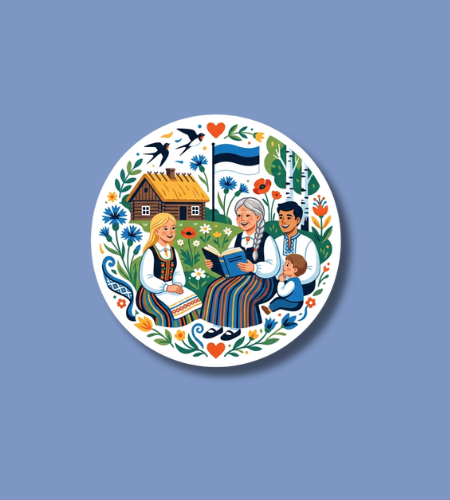
Mother Tongue Day in Estonia, known locally as Emakeelepäev, is a national holiday observed on March 14. The day honors the Estonian language and its survival through centuries of foreign influence. It was established to celebrate the birthday of Kristjan Jaak Peterson, a pioneer of Estonian poetry who was among the first to argue that a local peasant language was capable of expressing high literary thought. Today, it serves as a moment of national pride, emphasizing the preservation of linguistic heritage as a cornerstone of the country’s cultural identity.
Read also about Estonia Independence Day
Table of Contents
History of Mother Tongue Day in Estonia
The idea for this holiday was first proposed in 1995 by Meinhard Laks, a teacher and language enthusiast. He believed that the Estonian language deserved a specific day of recognition to ensure its continued development and to honor those who fought for its literary status. The date of March 14 was chosen to commemorate the birth of Kristjan Jaak Peterson in 1801. Peterson is a legendary figure who famously asked in his poetry whether the language of this land could not, in the wind of song, rise to the heavens to seek eternity. He died at the young age of 21, but his impact on the national awakening was profound.
The holiday gained official status in 1999 when the Estonian parliament, the Riigikogu, declared it a national day of significance. Since then, it has become a deeply rooted tradition in schools, media, and government institutions. The celebration is not just about looking at the past; it focuses on the living nature of the language and its ability to adapt to the digital age. By celebrating Peterson’s birthday, Estonians acknowledge the transition of their tongue from a rural dialect to a sophisticated, modern language used in science, technology, and international diplomacy.
Why is Mother Tongue Day in Estonia important?
This day is vital because the Estonian language is a primary symbol of the nation’s independence and resilience. For centuries, Estonia was under the rule of various empires, and the language faced periods where it was relegated to the domestic sphere while German or Russian dominated public life. Mother Tongue Day reinforces the right of a small nation to maintain its unique linguistic character. It serves as a reminder that a language is more than a communication tool; it is a repository of a people’s history, folklore, and specific way of perceiving the world.
Furthermore, the observance encourages linguistic excellence and the correct use of the language among younger generations. In an era of globalization where English often dominates the internet and business, the holiday reminds Estonians to cherish and develop their native vocabulary. It highlights the work of linguists, writers, and translators who keep the language vibrant. By focusing on the “mother tongue,” the day also fosters a sense of unity across the global Estonian diaspora, connecting people to their roots regardless of where they live.
- The holiday commemorates the birthday of the first great Estonian poet, Kristjan Jaak Peterson.
- It emphasizes the survival of the language despite centuries of foreign political pressure.
- Schools use the day to promote Estonian literature and the art of beautiful writing.
- The observance supports the continued development of Estonian as a language of modern science.
- National awards are often presented to individuals who have significantly contributed to the language.
How to Observe Mother Tongue Day in Estonia
The most widespread tradition of the day is the e-dictation (e-etteütlus) organized by Estonian Public Broadcasting. Tens of thousands of people, including students, politicians, and expats, participate simultaneously by writing a complex text broadcast on the radio to test their spelling and grammar. Many schools host poetry readings, essay competitions, and meetings with contemporary authors. Flags are traditionally hoisted on public buildings and private homes across the country to mark the occasion, creating a visual sense of national unity.
Families often celebrate by reading Estonian fairy tales or classic literature together. In many towns, wreaths are placed at monuments dedicated to Kristjan Jaak Peterson or other prominent linguists. The day is also used to discuss the future of the language, with conferences and lectures focusing on language technology and the role of Estonian in the European Union. Whether through a digital spelling test or a quiet afternoon with a book, the goal is to show respect for the linguistic heritage that defines the Estonian people.
- Participate in the national e-dictation competition hosted by the public radio.
- Attend a poetry reading or a literary evening at a local library or school.
- Read the works of Kristjan Jaak Peterson to honor his contribution to the language.
- Display the Estonian national flag on your home or place of business.
- Explore new Estonian music or theater productions that showcase the beauty of the language.
Mother Tongue Day in Estonia Dates Table
| Year | Date | Day |
|---|---|---|
| 2026 | March 14 | Saturday |
| 2027 | March 14 | Sunday |
| 2028 | March 14 | Tuesday |
| 2029 | March 14 | Wednesday |
| 2030 | March 14 | Thursday |
Subscribe to our newsletter and never miss a holiday again!