



National Limerick Day
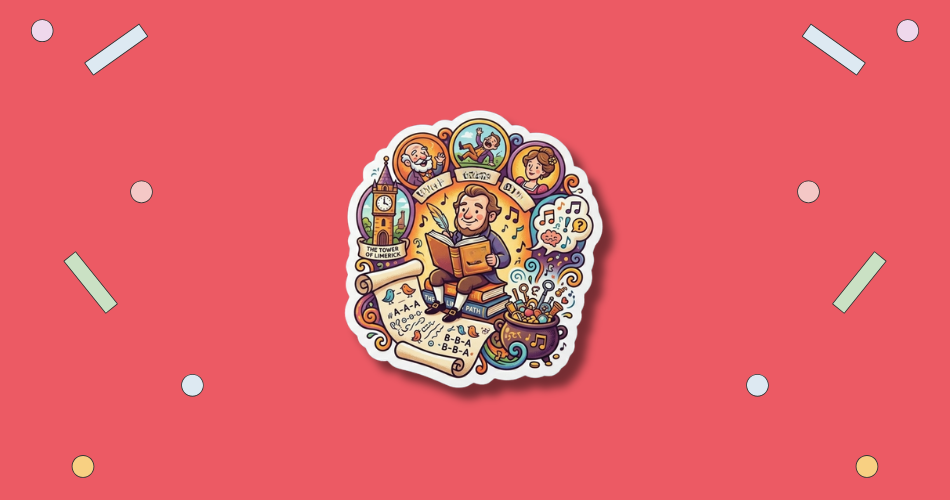
National Limerick Day is celebrated annually on May 12. This day honors the unique and often humorous form of poetry known as the limerick. It coincides with the birthday of Edward Lear, the English artist and writer who is widely credited with bringing this specific poetic structure into the mainstream during the 19th century. In 2027, this date falls on a Wednesday.
Contents
HT Meter
Does this day matter to you?
Tap the meter if it does, and say whether you will be celebrating — that is what opens the wishes from everybody else who will be.
This day matters to me
0 Be the first to say so
Just getting started
0 Let others know you’re in.
Wishes, greetings and stories
Join the celebration to share a wish, a greeting, or how this day goes in your house.
These are kept for the people celebrating this day. Say you will be celebrating to read them and to add your own.
You have already shared something here recently.
Nothing here yet. Yours would be the first.
See also: World Poetry Day, Great Poetry Reading Day, International Haiku Poetry Day, Poetry & The Creative Mind Day,
History of National Limerick Day

Edward Lear was born on May 12, 1812, and became famous for his “nonsense” poetry. Although the limerick form existed before him, his 1846 publication, A Book of Nonsense, featured over 70 limericks and helped establish the standard five-line format. Lear often paired his verses with whimsical illustrations, making the poetry accessible to children and adults alike. He published several more volumes of light verse throughout his career, cementing the limerick as a popular literary genre.
The exact origin of the term “limerick” remains a subject of debate among historians. Some suggest it refers to the city or county of Limerick in Ireland, possibly tied to a 18th-century Irish language poetic form. Others believe it stems from a common refrain in 19th-century parlor games that included the line “Will you come up to Limerick?” Regardless of the name’s source, the style became a staple of English literature as a way to convey jokes and lighthearted stories through a specific rhythm and rhyme.
Why is National Limerick Day important?
Limericks provide a structured yet flexible way for people to experiment with creative writing and rhythm. The AABBA rhyme scheme and the specific anapestic beat make these poems easy to remember and recite. This accessibility encourages literacy and linguistic playfulness in classrooms and households. Because the form is short, it allows writers to focus on punchlines and wit without the complexity of longer poetic styles.
National Leprechaun Day
The holiday also preserves a specific type of cultural humor that relies on wordplay and irony. Limericks often explore the absurd or the everyday in a funny way, helping people connect through shared laughter. By celebrating this day, society acknowledges the value of nonsense and the importance of finding humor in small things. It serves as a reminder of the historical impact that light verse has had on the English language and mass entertainment.
- It encourages people to try writing poetry in a simple and fun way
- The day honors the literary legacy of Edward Lear and his nonsense verse
- Writing limericks helps children develop a better sense of rhyme and rhythm
- The holiday celebrates a form of humor that uses clever wordplay
- It keeps a traditional style of storytelling alive for new generations
How to Celebrate National Limerick Day
Make it yours
How would you like to spend National Limerick Day?
Tick what fits you, and we will put together ideas made for this day — not for any day.
A popular way to mark the occasion is to write an original limerick about yourself, a friend, or a daily task. You can follow the classic structure by making the first, second, and fifth lines rhyme while keeping the third and fourth lines shorter with a different rhyme. Reading your work aloud to others highlights the rhythmic bounce of the poem, which is a key part of the limerick’s charm.
Sharing famous examples from books like Lear’s A Book of Nonsense is another common activity. Many libraries and schools host workshops or reading sessions where participants can listen to classic verses. For a more modern approach, you can post your favorite or original poems on social media platforms to engage with other fans of the genre. Participating in a limerick challenge with coworkers or family members creates an environment for friendly competition.
- Write a five-line poem following the traditional AABBA rhyme scheme
- Read a collection of nonsense poetry by Edward Lear to find inspiration
- Share a funny limerick with a friend or family member today
- Look up the history of the city of Limerick to see its cultural ties
- Post an original verse online using the official holiday hashtag
National Limerick Day Dates Table
| Year | Date | Day of the week |
|---|---|---|
| 2026 | May 12 | Tuesday |
| 2027 next | May 12 | Wednesday |
| 2028 | May 12 | Friday |
| 2029 | May 12 | Saturday |
| 2030 | May 12 | Sunday |
Sorry to hear you didn't enjoy this article...

National Clerihew Day
Help us make it better!