


Bolivia Independence Day
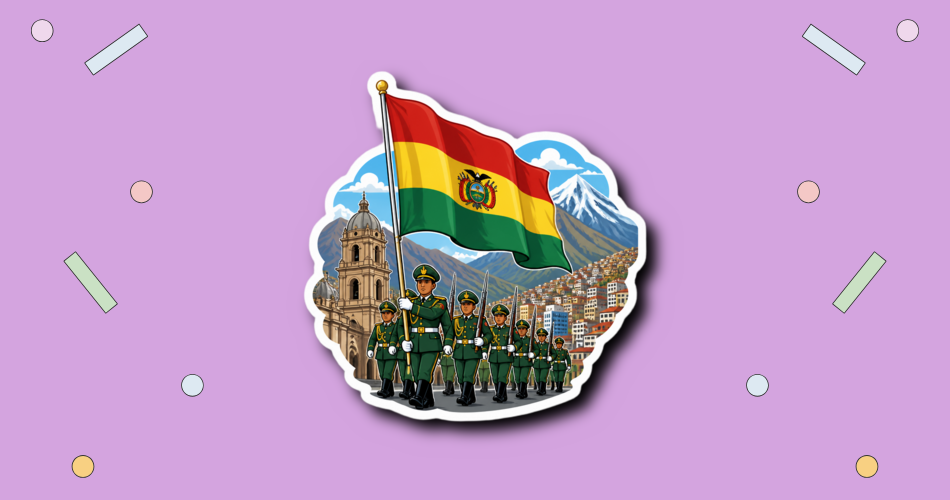
Bolivia Independence Day is celebrated annually on August 6. In 2027, this date falls on a Friday. Known locally as 'Dia de la Patria', this national holiday commemorates the signing of the Declaration of Independence in 1825, marking Bolivia's freedom from Spanish colonial rule. The day is observed with military parades, civic ceremonies, folk music, and fireworks across the country, with the largest celebrations taking place in La Paz and Sucre.
Contents
HT Meter
Does this day matter to you?
Tap the meter if it does, and say whether you will be celebrating — that is what opens the wishes from everybody else who will be.
This day matters to me
0 Be the first to say so
Just getting started
0 Let others know you’re in.
Wishes, greetings and stories
Join the celebration to share a wish, a greeting, or how this day goes in your house.
These are kept for the people celebrating this day. Say you will be celebrating to read them and to add your own.
You have already shared something here recently.
Nothing here yet. Yours would be the first.
History of Bolivia Independence Day
Bolivia's path to independence was long and arduous. Spanish colonizers arrived in the 1530s, establishing control over the region then known as Upper Peru. For nearly three centuries, the territory served as a critical source of silver for the Spanish crown, particularly from the mines of Potosí. Resistance movements gained momentum in the early 1800s, inspired by broader independence movements sweeping Latin America. Simón Bolívar and Antonio José de Sucre played pivotal roles in the military campaigns that ultimately freed Upper Peru from Spanish control.
On August 6, 1825, the newly independent republic officially declared its sovereignty. The nation was named Bolivia in honor of Simón Bolívar, who had championed the liberation cause. Sucre became the country's first constitutional capital, while La Paz later emerged as the seat of government. The Declaration of Independence was signed in Sucre (then known as Chuquisaca), making Bolivia one of the last South American nations to formally break from Spanish colonial rule.
Why is Bolivia Independence Day important?
August 6 represents the birth of a nation. The Declaration of Independence signed in 1825 was the culmination of years of armed struggle, political maneuvering, and sacrifice. For Bolivians, the day is a reminder of their ancestors' resilience and their country's sovereignty. The significance is amplified by Bolivia's extraordinary cultural diversity, with 36 officially recognized indigenous nations. Independence Day serves as a unifying moment when all Bolivians come together to celebrate a shared history.
Plurinational State Foundation Day
Bolivia Independence Day holds deep cultural and emotional weight for Bolivians at home and abroad. The celebrations are grand, the traditions are rich, and national pride is unmistakable. For the Bolivian diaspora, August 6 is a powerful connection to home, with communities in countries like Argentina, Brazil, Spain, and the United States marking the occasion with cultural events and traditional gatherings.
- The day honors the liberators Simón Bolívar and Antonio José de Sucre, who led the independence movement.
- It celebrates Bolivia's sovereignty and the end of over 300 years of Spanish colonial rule.
- The holiday provides an opportunity to recognize Bolivia's indigenous heritage, which is woven into the celebrations through traditional textiles, music, and ceremonial practices.
- It serves as a moment of national reflection on Bolivia's progress, political landscape, and ongoing project of national identity.
- The date unites Bolivians across diverse backgrounds, reinforcing a sense of shared history and national pride.
How to Celebrate Bolivia Independence Day
Make it yours
How would you like to spend Bolivia Independence Day?
Tick what fits you, and we will put together ideas made for this day — not for any day.
The most prominent celebrations take place in La Paz and Sucre, Bolivia's two capitals. Official ceremonies include military parades with uniformed soldiers and marching bands, civic ceremonies with government officials, flag-raising rituals, and a traditional Te Deum Mass at the Metropolitan Cathedral in Sucre. The Casa de la Libertad in Sucre, where the Declaration of Independence was signed, hosts official ceremonies, historical reenactments, and public events that draw visitors from across the country.
Beyond official ceremonies, Independence Day is a lively public holiday. Families gather for meals featuring traditional dishes like salteñas (savory pastries), pique macho (a hearty meat and vegetable dish), and chicha (a traditional fermented maize drink). Traditional music and dance performances fill public plazas, including the cueca and morenada. Fireworks light up the night sky in many cities and towns, capping off the day's events with spectacle.
- Attend the military parade in La Paz along Avenida del Ejército for a large-scale display of national pride.
- Visit the Casa de la Libertad museum in Sucre to see where the Declaration of Independence was signed.
- Enjoy traditional Bolivian folk dances and music performances, including colorful costumes and handmade instruments.
- Sample Bolivian cuisine such as salteñas, pique macho, and chicha at local gatherings or restaurants.
- Join Bolivian diaspora community events abroad to celebrate with cultural performances and traditional meals.
Bolivia Independence Day Dates
| Year | Date | Day of the week |
|---|---|---|
| 2026 | August 6 | Thursday |
| 2027 next | August 6 | Friday |
| 2028 | August 6 | Sunday |
| 2029 | August 6 | Monday |
| 2030 | August 6 | Tuesday |
Sorry to hear you didn't enjoy this article...
El Salvador Independence Day
Help us make it better!