
Madagascar Independence Day
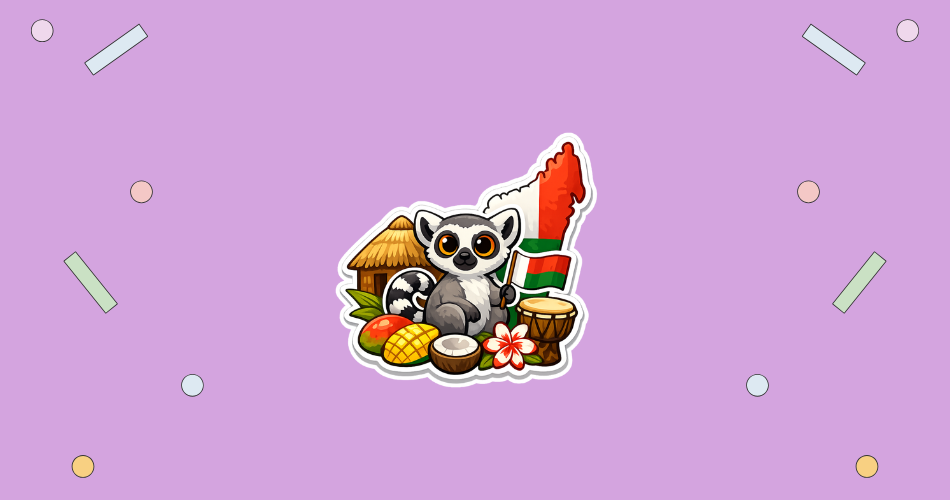
Madagascar Independence Day is observed every year on June 26. In 2027, this date falls on a Saturday. The day is a national public holiday in Madagascar and marks the country’s independence from France in 1960. It is also treated as Madagascar’s National Day, with patriotic ceremonies, public gatherings, flags, music, and family celebrations. The tone of the day is proud and festive, while still tied to a serious history of colonial rule, political change, and national self-determination. 1
Contents
See also: Libya Independence Day, Cambodia Independence Day, Independence Day in Cameroon
HT Meter
Does this day matter to you?
Tap the meter if it does, and say whether you will be celebrating — that is what opens the wishes from everybody else who will be.
This day matters to me
0 Be the first to say so
Just getting started
0 Let others know you’re in.
Wishes, greetings and stories
Join the celebration to share a wish, a greeting, or how this day goes in your house.
These are kept for the people celebrating this day. Say you will be celebrating to read them and to add your own.
You have already shared something here recently.
Nothing here yet. Yours would be the first.
History of Madagascar Independence Day
Madagascar became a French colony at the end of the 19th century after a period of French military intervention and the removal of the monarchy. In the decades that followed, Malagasy political life was shaped by colonial administration, resistance, and demands for greater representation. A major uprising against French rule took place in 1947, and although it was violently suppressed, it remained an important part of the country’s independence story. By the late 1950s, reforms within the French colonial system opened the way for Madagascar to move toward autonomy and then independence.
Maldives Independence Day
The Malagasy Republic was proclaimed as an autonomous state within the French Community in 1958. Philibert Tsiranana became a leading political figure during this transition and later served as the first president of independent Madagascar. Full independence was achieved on June 26, 1960, which is why the date became the country’s annual Independence Day. Today, the holiday connects modern Madagascar with the moment it formally gained control of its own national future.
Why is Madagascar Independence Day important?
Madagascar Independence Day is important because it honors the country’s sovereignty and the political milestone that ended French colonial rule. For Malagasy citizens, June 26 is more than a date on the calendar; it is a public expression of national identity. The holiday gives attention to the flag, the republic, civic life, and the shared memory of becoming an independent nation. It also gives families and communities a reason to gather around a story that belongs to the whole country.
The day also matters because Madagascar has a distinct cultural and historical identity shaped by its island geography, Malagasy language, regional traditions, and connections across Africa, the Indian Ocean, and Southeast Asia. Independence Day helps keep that identity visible in public life. It offers a way for younger generations to learn why 1960 matters and why national symbols carry emotional weight. For people in the Malagasy diaspora, the day can also be a connection to home, heritage, and community.
- It marks Madagascar’s independence from France in 1960.
- It honors the country’s national identity and sovereignty.
- It keeps public attention on Malagasy history.
- It gives families a shared civic celebration.
- It connects Malagasy communities at home and abroad.
How to Celebrate Madagascar Independence Day
Make it yours
How would you like to spend Madagascar Independence Day?
Tick what fits you, and we will put together ideas made for this day — not for any day.
Malawi Independence Day
Raise or display the Malagasy flag, learn the meaning of its red, white, and green colors, or read a short history of the country’s independence. In Madagascar, the day is commonly associated with public ceremonies, parades, patriotic displays, music, fireworks, and gatherings with family and friends. Food, conversation, and neighborhood celebrations often form an important part of the holiday atmosphere. For people outside Madagascar, the day can be marked by cooking Malagasy food, listening to Malagasy music, or sharing the story of June 26 with others.
A more thoughtful way to mark the day is to learn about the events that came before independence, including colonial rule, the 1947 uprising, and the political changes of the late 1950s. Students and families can look at maps, biographies, and reliable history materials to understand how Madagascar’s independence fits into the broader wave of African decolonization. Cultural groups can organize small community events that highlight Malagasy language, dance, music, and storytelling. The day works best when celebration and memory are held together.
- Display the Malagasy flag at home or at an event.
- Read about Madagascar’s road to independence.
- Cook a Malagasy dish for family or friends.
- Listen to Malagasy music or traditional performance.
- Share the meaning of June 26 with younger people.
Madagascar Independence Day Dates
| Year | Date | Day of the week |
|---|---|---|
| 2026 | June 26 | Friday |
| 2027 next | June 26 | Saturday |
| 2028 | June 26 | Monday |
| 2029 | June 26 | Tuesday |
| 2030 | June 26 | Wednesday |