
Israel Independence Day (Memorial Day in Israel)
Israel Independence Day (Yom HaAtzmaut) and Memorial Day (Yom HaZikaron) are two of the most significant days in the Israeli calendar. They are intentionally observed back-to-back to symbolize the heavy price paid in lives for the establishment and continued existence of the state.
Contents
HT Meter
Does this day matter to you?
Say that it does, and say whether you will be marking it. Both are anonymous to nobody but kind to everybody.
This day matters to me
0 Be the first to say so
Quietly remembered
0 Nobody has said so yet
Notes of remembrance
Join those marking this day to share a word, a memory, or the reason it matters to you.
These notes are kept for the people marking this day. Say you will be marking it to read them and to leave your own.
You have already shared a note here recently.
No notes yet. Yours would be the first.
Both are set by the Hebrew calendar and by the Independence Day Law of 1949, which keeps them clear of the Sabbath: when 5 Iyar falls on a Friday or a Saturday the pair is brought forward to the Thursday, and when it falls on a Monday it is put back to the Tuesday. In 2027, this date falls on May 12.
- Yom HaZikaron (Memorial Day) falls on 4 Iyar, the day before Independence Day, and begins at sundown the evening before that.
- Yom HaAtzmaut (Independence Day) falls on 5 Iyar and begins at sundown the evening before, as Yom HaZikaron ends.
See also: National Israel Day, Yom HaShoah
Yom HaZikaron (Israeli Memorial Day)
This is a day of collective mourning for all Israeli military personnel who lost their lives in the line of duty and for victims of terror. Unlike many Western memorial days, it is a deeply somber, nationwide observance where the entire country effectively comes to a standstill.
Key Traditions:
- The Sirens
Two national sirens are sounded. The first (one minute) occurs at 8:00 p.m. to mark the start of the day, and the second (two minutes) occurs at 11:00 a.m. the following morning. During these sirens, all activity stops; people stand in silence, and motorists pull over on highways to stand by their vehicles. - Public Closures
All places of entertainment, including theaters, cinemas, and restaurants, are legally required to close. Television and radio stations broadcast only somber music and documentaries about fallen soldiers. - State Ceremonies
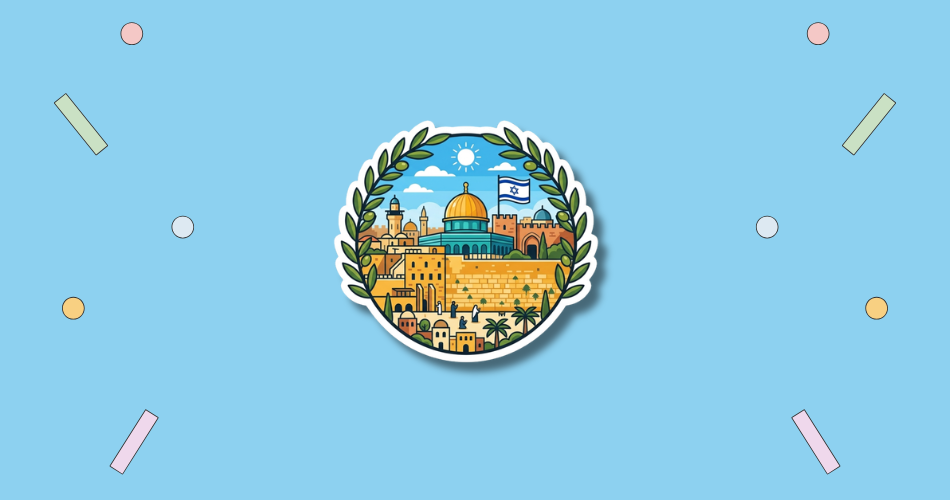
Major ceremonies are held at the Western Wall and military cemeteries across the country. Families visit the graves of their loved ones to light candles and recite prayers.
Yom HaAtzmaut (Israel Independence Day)
The transition from the profound grief of Memorial Day to the exuberant celebration of Independence Day happens in a single moment at sundown, a shift known as Ma’avar (The Transition).
Key Traditions:
- Torch-Lighting Ceremony
The official celebrations begin on Mount Herzl in Jerusalem with a ceremony where twelve torches are lit, representing the twelve tribes of Israel, usually by citizens who have made significant contributions to society. - The “Mangal” (Barbecue)
The unofficial national pastime of Yom HaAtzmaut is the outdoor barbecue. Parks and beaches across Israel are packed with families grilling meat and celebrating together. - The Flyover
The Israeli Air Force (IAF) performs a celebratory flyover across the entire country, featuring various fighter jets and transport planes. - Street Parties
Cities host major outdoor concerts, fireworks displays, and street parties. A unique tradition involves children (and some adults) “hitting” each other with plastic squeaky hammers and spraying blue-and-white shaving cream in the streets.
Israel Independence Day (Memorial Day in Israel) Dates
| Year | Date | Day of the week |
|---|---|---|
| 2026 | April 22 | Wednesday |
| 2027 next | May 12 | Wednesday |
| 2028 | May 2 | Tuesday |
| 2029 | April 19 | Thursday |
| 2030 | May 8 | Wednesday |
Sorry to hear you didn't enjoy this article...
National Israel Day
Help us make it better!

Make it yours
How would you like to spend Israel Independence Day (Memorial Day in Israel)?
Tick what fits you, and we will put together ideas made for this day — not for any day.