


National Look Up at the Sky Day

National Look Up at the Sky Day is a day of mindfulness and nature appreciation observed annually on April 14. In 2027, this date falls on a Wednesday. This observance encourages people to pause their hectic daily routines, step outside, and spend time observing the vast expanse above them, whether to admire the shifting patterns of clouds during the day or the placement of stars and planets at night.
Contents
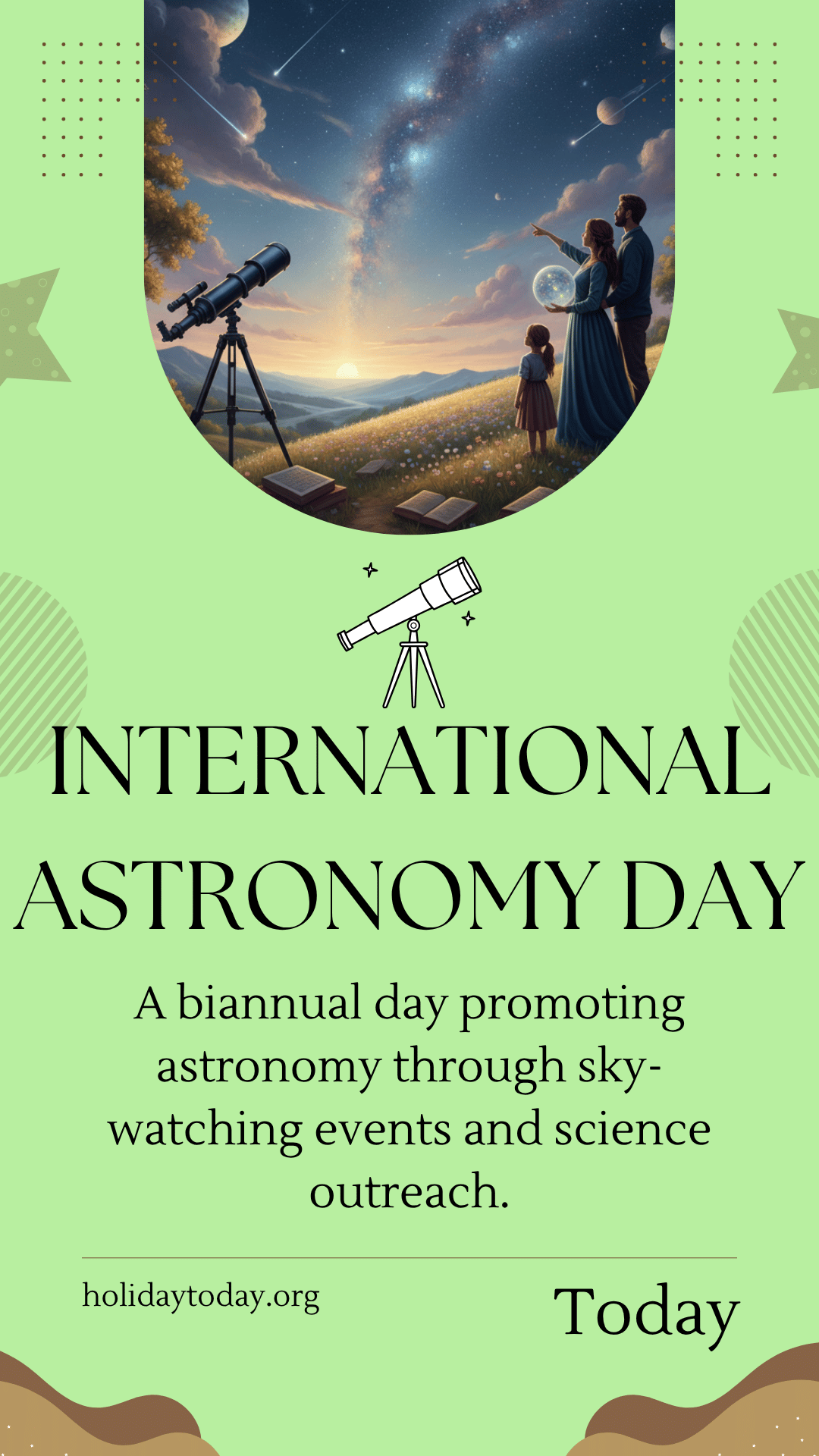
Read also about National Find a Rainbow Day, International Astronomy Day
HT Meter
Does this day matter to you?
Tap the meter if it does, and say whether you will be celebrating — that is what opens the wishes from everybody else who will be.
This day matters to me
0 Be the first to say so
Just getting started
0 Let others know you’re in.
Wishes, greetings and stories
Join the celebration to share a wish, a greeting, or how this day goes in your house.
These are kept for the people celebrating this day. Say you will be celebrating to read them and to add your own.
You have already shared something here recently.
Nothing here yet. Yours would be the first.
History of National Look Up at the Sky Day
The exact origin of this holiday is not documented in official government records, but it is widely associated with the work of Jack Borden, a former news reporter from Boston. In the late 1970s, Borden reportedly had a life-changing experience when he realized he had spent decades without truly noticing the beauty and scale of the sky. This epiphany led him to quit his career and found the non-profit organization For Spacious Skies in the 1980s. The group’s primary mission was to encourage environmental awareness and improve literacy and arts education by using the sky as a universal, ever-changing classroom.

International Astronomy Day (Spring)
The day serves as a tribute to the broader human fascination with the heavens, which dates back to ancient civilizations like the Babylonians and Mayans who used the sky for navigation and timekeeping. While the “national” designation is informal and driven by grassroots popularity, the date of April 14 has become the standard time for educators and wellness advocates to promote the practice. Over the years, the day has evolved from a niche environmental campaign into a social media event where participants share photos of unique cloud formations and celestial events to inspire others to disconnect from their screens and look upward.
Why is National Look Up at the Sky Day important?
This day is significant because it addresses the modern “disconnection” from the natural world caused by urbanization and the constant use of handheld technology. Looking up provides a literal change in perspective, helping individuals realize their place within a much larger universe. This shift in viewpoint is often cited by mental health professionals as a simple way to reduce stress, as the vastness of the sky can help put personal problems and daily anxieties into a more manageable context.
The observance also plays a role in scientific and environmental education. By encouraging people to notice the sky, it raises awareness about issues like light pollution, which currently prevents a large portion of the global population from seeing the Milky Way. It serves as an entry point for amateur astronomy and meteorology, prompting curious observers to learn about different cloud types, the physics of sunsets, and the movement of the solar system. This increased awareness fosters a deeper respect for the atmosphere and the need to protect the air quality and natural darkness of the environment.
- It helps individuals practice mindfulness by focusing on the present moment.
- The day encourages a break from the physical strain of looking down at digital devices.
- It promotes interest in STEM subjects like astronomy and atmospheric science.
- Communities become more aware of the impact of light pollution on local wildlife.
- The observance provides a free and accessible way for anyone to connect with nature.
How to Celebrate National Look Up at the Sky Day
Make it yours
How would you like to spend National Look Up at the Sky Day?
Tick what fits you, and we will put together ideas made for this day — not for any day.

National Meteor Watch Day
Celebrating this day is as simple as finding an open space and spending several minutes in quiet observation. Many people choose to lie on the grass to watch the movement of cumulus or cirrus clouds, a practice that encourages creativity as the mind identifies familiar shapes in the formations. For those observing after dark, the day is an ideal time to visit a local “dark sky” park or use a basic star-chart app to identify major constellations like the Big Dipper or Orion.
In educational settings, teachers often mark the day by leading students in sky-themed activities, such as sketching the horizon or recording the colors of a sunset. Because the sky is a shared resource, celebrating also involves communal activities like attending a planetarium show or participating in a neighborhood “star party” with telescopes. The atmosphere of the day is intended to be one of wonder and curiosity, reminding everyone that a world of scientific mystery and artistic beauty is always visible just by tilting one’s head back.
- Take a walk to a high point in your area to get an unobstructed view of the horizon.
- Try to identify three different types of clouds throughout the day.
- Spend fifteen minutes stargazing away from bright streetlights at night.
- Take a photo of the sky at different times of the day to see how the light changes.
- Share a fun fact about space or weather with a friend to spark a conversation.
National Look Up at the Sky Day Dates Table
| Year | Date | Day of the week |
|---|---|---|
| 2026 | April 14 | Tuesday |
| 2027 next | April 14 | Wednesday |
| 2028 | April 14 | Friday |
| 2029 | April 14 | Saturday |
| 2030 | April 14 | Sunday |